There was some kind of catastrophic disaster. Fire was all around. Then there was an explosion or fire and light and on the other side life had changed. Many people including myself were burned beyond recognition but we were alive and functioning. New ways of doing thing had to be developed because people could barely move. A new language formed because people could barely talk. The interesting part is that this was NOT a nightmare. There was no pain, no fear, no depression, no anxiety. People just continued doing the best they could living their lives. Do you see a parallel with being a caregiver for or the person afflicted with Alzheimer's? I do. I also see that something that could have been a catastrophe ended up reflecting the ability of human nature to rise to the occasion.
Thursday, March 31, 2011


Tuesday, March 29, 2011
Why is it?
Why is it that I still have expectatons? Why is it that I still think he can learn? Why is it that I am surprised when he doesn't make connections? Why is it that I still ask him to do things to help me? Why is it that I still reason with him. Why is it that I still discuss things with him? Why is it that I still get angry and frustrated with him?
I guess because it is a measure of my respect for the person he was and is. Should I treat him like an idiot? Should I treat him like a child? Should I treat him as though he doesn't exist, or matter, or have emotions? I don't think I could do that.
So I just have to remind myself that when he doesn't meet my expectations, when he can't learn, when he can't make connections, when he can't help, when he can't be reasoned with ... I need to not get angry or frustrated ... just be patient and compassionate. The choice is mine.
I guess because it is a measure of my respect for the person he was and is. Should I treat him like an idiot? Should I treat him like a child? Should I treat him as though he doesn't exist, or matter, or have emotions? I don't think I could do that.
So I just have to remind myself that when he doesn't meet my expectations, when he can't learn, when he can't make connections, when he can't help, when he can't be reasoned with ... I need to not get angry or frustrated ... just be patient and compassionate. The choice is mine.
Sunday, March 27, 2011


Thursday, March 24, 2011
Predictibablity
The green plants are always there,
Sitting on the bedroom bookcase top,
With several other items of interest.
Nothing needs be done,
No decisions made,
It always remains the same.
The living room window sill,
Sports in a row - Buddha, Ganesh,
An African Protection Fetish.
Sitting on the bedroom bookcase top,
With several other items of interest.
Nothing needs be done,
No decisions made,
It always remains the same.
The living room window sill,
Sports in a row - Buddha, Ganesh,
An African Protection Fetish.
Nothing needs be done.
No decisions made.
It always remains the same.
Each night at bedtime they are tapped lovingly,
One by one in his concentrated way,
Counting on at least one predictable, familiar experience.
Wednesday, March 23, 2011
Tonight
Tonight he forgot how to put body lotion onto his hand. It hovered above the pump, retreated, approached, retreated, approached. Finally he figured it out.
After reading for awhile, he put his book down on the night table, picked up the case for his reading glasses, opened it, closed it, then realized he still had his reading glasses in his hand. He corrected the situation in silence. Unnoticed I watched.
He fluffed his pillow, laid down, said goodnight to the plants on the bookcase, and turned off the lamp. Some solace in that I guess.
After reading for awhile, he put his book down on the night table, picked up the case for his reading glasses, opened it, closed it, then realized he still had his reading glasses in his hand. He corrected the situation in silence. Unnoticed I watched.
He fluffed his pillow, laid down, said goodnight to the plants on the bookcase, and turned off the lamp. Some solace in that I guess.
Tuesday, March 22, 2011
When Teaching and Learning No Longer Work
What happens when teaching and learning no longer work? Think about that one!
Monday, March 21, 2011
Letting Go
After the events, probably usual events, of going to bed this evening upset me I went into the closet, no lights, and cried, no longer productive nor comforting to cry in the arms of my love. And as I cried and realized why I was upset, I whispered over and over, "It is so hard to let go. It is so hard to let go. It is so hard to let go."
Then my mind said to me, "There is power in words. If you say it is hard then it will be hard!"
So I started chanting, "I am letting go. I am letting go. I am letting go." And as I chanted I became more in touch with my emotions, cried harder, cried tears, cried grief.
Maybe I can tell myself to "let go" before I get upset ... "but is is so hard." Maybe that is a good compromise, "I am letting go and it is hard."
Mary's Mother
Received this lovely e-mail this morning and wanted to share it with you.
Michael
I learned to meet my mother, brand new, every time I saw her.... I was always thankful she wasn't in pain and didn't know sorrow... She was like a child. She even forgot that she was once petrified of dogs... how wonderful that she forgot that horror. She did not suffer, she just didn't remember things. Her mental buffers were no longer full, overflowing with useless trivia, data, "to do" lists and reminders. She marveled at life, and loved watching finches fluttering around the bird feeder in the back yard. Her life became simpler each day. I often envied that simplicity and sometimes wish I were so lucky.
I love your sweet blogs. Thanks for sharing your journey.
Aloha from Kauai
Mary
Wednesday, March 16, 2011
The Journey
This poem was shared with me by my friend Pat. I agree with her comment: "It makes me feel a little breathless."
The Journey
One day you finally knew
what you had to do, and began,
though the voices around you
kept shouting
their bad advice--
though the whole house
began to tremble
and you felt the old tug
at your ankles.
"Mend my life!"
each voice cried.
But you didn't stop.
You knew what you had to do,
though the wind pried
with its stiff fingers
at the very foundations,
though their melancholy
was terrible.
It was already late
enough, and a wild night,
and the road full of fallen
branches and stones.
But little by little,
as you left their voices behind,
the stars began to burn
through the sheets of clouds,
and there was a new voice
which you slowly
recognized as your own,
that kept you company
as you strode deeper and deeper
into the world,
determined to do
the only thing you could do--
determined to save
the only life you could save.
what you had to do, and began,
though the voices around you
kept shouting
their bad advice--
though the whole house
began to tremble
and you felt the old tug
at your ankles.
"Mend my life!"
each voice cried.
But you didn't stop.
You knew what you had to do,
though the wind pried
with its stiff fingers
at the very foundations,
though their melancholy
was terrible.
It was already late
enough, and a wild night,
and the road full of fallen
branches and stones.
But little by little,
as you left their voices behind,
the stars began to burn
through the sheets of clouds,
and there was a new voice
which you slowly
recognized as your own,
that kept you company
as you strode deeper and deeper
into the world,
determined to do
the only thing you could do--
determined to save
the only life you could save.
Monday, March 14, 2011
Only Two
Gregory and I had a long conversation today.
It was good for me, I am not sure how much of it he was able to follow. But my belief is still that I have two choices when things go wrong: 1) Pretend that nothing is wrong or 2) Discuss it with him.
He always chooses the later when offered the choice so I continue to discuss it with him when things go wrong. Most often the steps are too many and he cannot follow the discussion but we try anyway. If it really doesn't matter, I do pretend.
After our conversation today, Gregory said that he felt bad that his problem might mean that I can no longer be away from him to do the things I like to do.
I replied, "You know there are only two times when I feel bad about our 'situation.'
One is when I loose control and get angry or short or impatient or disrespectful and the other is when you feel bad.
We laughed.
It was good for me, I am not sure how much of it he was able to follow. But my belief is still that I have two choices when things go wrong: 1) Pretend that nothing is wrong or 2) Discuss it with him.
He always chooses the later when offered the choice so I continue to discuss it with him when things go wrong. Most often the steps are too many and he cannot follow the discussion but we try anyway. If it really doesn't matter, I do pretend.
After our conversation today, Gregory said that he felt bad that his problem might mean that I can no longer be away from him to do the things I like to do.
I replied, "You know there are only two times when I feel bad about our 'situation.'
One is when I loose control and get angry or short or impatient or disrespectful and the other is when you feel bad.
We laughed.
Sunday, March 13, 2011
Me or Him?
After seeing a sign on the elevator and not knowing my opera performance schedule, I said aloud, "I don't know if I will be here to go to the Condo Association meeting."
Gregory responded, "If he isn't going, I'm not going."
I smiled.
Gregory responded, "If he isn't going, I'm not going."
I smiled.
Friday, March 11, 2011
Conversing With My Love
Like the broken glass of a window pane
His thoughts are fractured.
‘This’ doesn’t follow ‘that’
And next is nowhere to be seen.
Like flocks of sparrows
Letters organize into words
But without meaning
Without understanding.
Like prisoners escaping into the streets
Sentences break free of logic.
They no longer reach their end
And sometimes start past their beginning.
Like runners passing in leaps and bounds
Time avoids smooth ticks or tocks.
We spend our days together as they come
And as they go or as they have or haven't been.
Thursday, March 10, 2011
Just Checking In
Hi. It's been a while since I've posted so I guess you can assume that for now (how ever long that may last) things have settled down. That either means that Gregory's changes and lapses have slowed down or he has not been challenged or confused recently or it means that I have reached a new level of coping, supporting, anticipating, covering, running interference, etc.
Oh, did I mention that that last Tuesday: 1) He didn't remember how to use his key to get into condo ... but did have sense to get help from management office. 2) Because the ususal “lunch meat” in the refrigerator ran out I left him a tin of tuna for lunch but the change caused him to be totally confused about how to make lunch ... but did have sense to go out to a restaurant. and 3) He forgot how to run DVD again even though it is “one button on” and “the same button off." Then he knew how to turn off the DVD after the movie with the “one button” ... but when I complimented him, he thought he had done it all wrong and apologized.
But you know what, I remained even and that helped both of us.
Oh, did I mention that that last Tuesday: 1) He didn't remember how to use his key to get into condo ... but did have sense to get help from management office. 2) Because the ususal “lunch meat” in the refrigerator ran out I left him a tin of tuna for lunch but the change caused him to be totally confused about how to make lunch ... but did have sense to go out to a restaurant. and 3) He forgot how to run DVD again even though it is “one button on” and “the same button off." Then he knew how to turn off the DVD after the movie with the “one button” ... but when I complimented him, he thought he had done it all wrong and apologized.
But you know what, I remained even and that helped both of us.
Sunday, March 6, 2011
Half Full or Half Empty
Is the glass half full or half empty? At dinner, I usually drink two glasses of water and Gregory usually doesn't drink any of his. The usual routine is that I hand him my empty glass and he gets me a refill from the water tap in the refrigerator. Sometimes he asks if I want more ice.
This evening I handed him my glass and asked for "A little more ice also please." In the time it took for him to put my glass down on his place mat and finish chewing his mouthful, he forgot which glass was mine.
First he picked up his glass but when he got to the refrigerator he realized it was already full. He brought it back. Put it down. Studied the area. Then pointed at the empty glass and said, "This one must be mine." Which confused him more.
"No, mine is the empty one."
"Oh." He picked up the empty one, took it to the refrigerator, filled it half way, and returned it to me. I thanked him, not commenting on the lack of any additional ice.
Now you tell me, half full or half empty?
This evening I handed him my glass and asked for "A little more ice also please." In the time it took for him to put my glass down on his place mat and finish chewing his mouthful, he forgot which glass was mine.
First he picked up his glass but when he got to the refrigerator he realized it was already full. He brought it back. Put it down. Studied the area. Then pointed at the empty glass and said, "This one must be mine." Which confused him more.
"No, mine is the empty one."
"Oh." He picked up the empty one, took it to the refrigerator, filled it half way, and returned it to me. I thanked him, not commenting on the lack of any additional ice.
Now you tell me, half full or half empty?
Saturday, March 5, 2011
A Recurring Theme
If you have been following this BLOG, or the events in Gregory and my life, you may have noticed that there seems to be a recurring theme: Expect Less, Love More.
As the disease continues to play havoc with Gregory's brain (I can actually picture the cells being destroyed one by one and the brain connections being snuffed out one by one) my learning curve and the progress of Gregory's Alzheimer's continues to present new, and different, and unexpected, and unfathomable experiences for me.
My goals are to do the best I can to keep him content, healthy, and safe. A sub-goal is to help his life be meaningful for him, to help him keep his dignity, to help keep him useful so he knows he is needed.
My goals might also include the same for me, especially keeping my mind and body healthy. I have to admit that while I know the importance of these personal goals about me, and while I do work at them, they do suffer.
As the changes continue to take place, sometimes at an accelerated rate, new levels difficulty in accomplishing my goals for him seem to come into play. For example last night there were several instances in which he was unable to follow very simple, one step directions.
They were based on easy to do (at least in my mind,) basic, up until now successful skills for him. One was to put cup cake papers in the cup cake tin. Another was to fill the dinner water glasses again for use at bedtime. A third was to pick up the cat's food for the evening.
Another example just happened as I was writing this BLOG. While he still seems able to us the computer to read his e-mail, see the day's news, and play an online game with Ken ... the computer and its use entails such a complex set of skills that he usually get confused and comes to me for help.
This time he was looking at the TRASH list of his e-mail, not today's e-mails. He was asking for my help but I didn't know how to help. The possibilities of why he needed help were so numerous that I didn't know where to begin. I didn't know how he ended up being in the TRASH. Explaining what was going on would only serve to confuse him. Asking questions to try to figure out how he got himself "cornered" only serves to confuse him more. Asking what he did just before he asked for the help is no longer part of his memory.
Last night was so frustrating that each time I just asked him to stop helping and I took over. His feelings were hurt but I knew that if I tried to explain what was expected, or how to do what I requested, he would only get more confused and I would get more frustrated (read angry.) So I just gently said, "Never mind honey, I'll do it." But he got his feeling hurt anyway.
It was then that I realized that currently, in many things, my helping him has become a choice between hurting his feeling less or hurting his feelings more. Let me repeat: hurting his feelings less or hurting his feelings more. Less is the obvious choice but non-the-less it hurts his feelings. So I cried.
Until now I have held the belief that in an effort to help him keep his dignity and sense of usefulness, it was worth the frustration, aggravation, and sometimes anger that I suffered when he could not follow through.
I no longer believe that it is worth my frustration, aggravaiton, and sometimes anger and especially not my emotional and physical health, when he cannot follow through.
So I will need to analyze each request for help more carefully and judge by his chance of success to determine if I even want to ask for help in the first place.
I will need to ask less, expect less, and love more. Him and myself.
He came to me to sooth my upset and said, "You can't always be perfect. Neither can I." So I cried more.
As the disease continues to play havoc with Gregory's brain (I can actually picture the cells being destroyed one by one and the brain connections being snuffed out one by one) my learning curve and the progress of Gregory's Alzheimer's continues to present new, and different, and unexpected, and unfathomable experiences for me.
My goals are to do the best I can to keep him content, healthy, and safe. A sub-goal is to help his life be meaningful for him, to help him keep his dignity, to help keep him useful so he knows he is needed.
My goals might also include the same for me, especially keeping my mind and body healthy. I have to admit that while I know the importance of these personal goals about me, and while I do work at them, they do suffer.
As the changes continue to take place, sometimes at an accelerated rate, new levels difficulty in accomplishing my goals for him seem to come into play. For example last night there were several instances in which he was unable to follow very simple, one step directions.
They were based on easy to do (at least in my mind,) basic, up until now successful skills for him. One was to put cup cake papers in the cup cake tin. Another was to fill the dinner water glasses again for use at bedtime. A third was to pick up the cat's food for the evening.
Another example just happened as I was writing this BLOG. While he still seems able to us the computer to read his e-mail, see the day's news, and play an online game with Ken ... the computer and its use entails such a complex set of skills that he usually get confused and comes to me for help.
This time he was looking at the TRASH list of his e-mail, not today's e-mails. He was asking for my help but I didn't know how to help. The possibilities of why he needed help were so numerous that I didn't know where to begin. I didn't know how he ended up being in the TRASH. Explaining what was going on would only serve to confuse him. Asking questions to try to figure out how he got himself "cornered" only serves to confuse him more. Asking what he did just before he asked for the help is no longer part of his memory.
Last night was so frustrating that each time I just asked him to stop helping and I took over. His feelings were hurt but I knew that if I tried to explain what was expected, or how to do what I requested, he would only get more confused and I would get more frustrated (read angry.) So I just gently said, "Never mind honey, I'll do it." But he got his feeling hurt anyway.
It was then that I realized that currently, in many things, my helping him has become a choice between hurting his feeling less or hurting his feelings more. Let me repeat: hurting his feelings less or hurting his feelings more. Less is the obvious choice but non-the-less it hurts his feelings. So I cried.
Until now I have held the belief that in an effort to help him keep his dignity and sense of usefulness, it was worth the frustration, aggravation, and sometimes anger that I suffered when he could not follow through.
I no longer believe that it is worth my frustration, aggravaiton, and sometimes anger and especially not my emotional and physical health, when he cannot follow through.
So I will need to analyze each request for help more carefully and judge by his chance of success to determine if I even want to ask for help in the first place.
I will need to ask less, expect less, and love more. Him and myself.
He came to me to sooth my upset and said, "You can't always be perfect. Neither can I." So I cried more.
Wednesday, March 2, 2011
Unbelievable
Amazing how the human brain works.
Amazing how the human brain doesn't work.
Gregory was beginning to get his breakfast together. I was awake so I offered to make him oatmeal. He liked the idea. I said, "Get everything else ready for your breakfast then I will make the oatmeal. Besides cereal he makes some kind of protein in the way of tinned fish or sausage, fresh fruit, and hot tea. Pretty healthy huh?
To get to the point, my offer to make him oatmeal (to be his cereal for the day,) totally got him off track. He lost all the details of what to do to make his breakfast. Forgot what to do before I made the cereal. Couldn't think about the protein, couldn't figure out the fresh fruit, put the box of tea back in the cabinet, and then stood there, confused.
I repeated, "Do everything you usually do for breakfast, but I'll do the cereal."
Blank.
I took him over to the cabinet where the pictured sign is posted that shows what he needs to do each day for breakfast.
Blank.
I said, "Tell you what. Forget what I said. Make your own breakfast." I put away all the makings for oatmeal. "I'm sorry I confused you. Make your own breakfast. I'll do oatmeal for both of us on another day."
"OK," he replied, "that would probably be better."
At this point in my writing I just asked him if he was back on track and he answered, "Yea."
Meanwhile I am amazed at what does (or doesn't) go on in his brain.
Amazing how the human brain doesn't work.
Gregory was beginning to get his breakfast together. I was awake so I offered to make him oatmeal. He liked the idea. I said, "Get everything else ready for your breakfast then I will make the oatmeal. Besides cereal he makes some kind of protein in the way of tinned fish or sausage, fresh fruit, and hot tea. Pretty healthy huh?
To get to the point, my offer to make him oatmeal (to be his cereal for the day,) totally got him off track. He lost all the details of what to do to make his breakfast. Forgot what to do before I made the cereal. Couldn't think about the protein, couldn't figure out the fresh fruit, put the box of tea back in the cabinet, and then stood there, confused.
I repeated, "Do everything you usually do for breakfast, but I'll do the cereal."
Blank.
I took him over to the cabinet where the pictured sign is posted that shows what he needs to do each day for breakfast.
Blank.
I said, "Tell you what. Forget what I said. Make your own breakfast." I put away all the makings for oatmeal. "I'm sorry I confused you. Make your own breakfast. I'll do oatmeal for both of us on another day."
"OK," he replied, "that would probably be better."
At this point in my writing I just asked him if he was back on track and he answered, "Yea."
Meanwhile I am amazed at what does (or doesn't) go on in his brain.
Tuesday, March 1, 2011
The Way We Speak Now
This piece was shared with me by my friend Pat. She said, "This is a lovely piece; I think you will enjoy it too. I am not recommending it b/c of Alzheimer’s, but just because it is evocative and strange and imaginative."
I think it is strong for anyone dealing with Alzheimer's as well. Let me know what you think.
The Way We Speak Now
by Angi Becker Stevens
The first word we lost was the name of that thing with the buttons, the one you speak into to talk to someone who is far away or at least not in the same room. The thing you call people with. We woke up one day and the word was just gone, no one anywhere could remember it. It even vanished from dictionaries, as far as we knew, though in all fairness no one could recall how to spell it to look it up. At first we thought it might just be a fluke, but a few days later another word went missing, this time the word for those gray strips of pavement—not roads, but the ones for walking. After a few more words had disappeared, we realized it was just going to keep on that way. There didn't seem to be any connection between the things that no longer had names; some were objects and some were places and some were feelings or foods or parts of the body. The tall things with leaves that grow out of the ground and up toward the sky, those things we get wood from. The things we put on our feet before we go outside. The joint where our legs bend. The specific emptiness we feel when we need to be fed.
Some people have had the idea to try to come up with replacements, but the new words just won't stick, as if this is not really a matter of words abandoning us, but of things that refuse to be named.
At some point we lost track of how many words have gone. There's no doubt anymore whether they have been vanishing from dictionaries as well—dictionaries are getting thinner. Other books are not getting thinner, but are merely developing empty spaces. I wonder how long it will be before they are filled with blank pages, every last one turned into a sketch pad, or a journal if there's anything left to write.
So far, we have managed to adapt. There are ways to describe almost anything. Sometimes I think about this game we used to play when I was a kid, where you tried to make your teammates guess a word without using a certain list of closely related words, like you would not be able to use the word "orange" if you were trying to make someone guess "carrot." When we lost the word for the color of the sky, I thought about how maybe playing that game was good practice. I can't remember the name of the game, but I don't think it's a vanished word. I think it's something I just forgot on my own.
The words that are gone are like hundreds of tiny phantom limbs. They feel constantly like they are on the tip of my tongue. The sensation reminds me of the way I felt during the final few months my lover and I spent together, like I always had a mouthful of words I could not form the right shape for no matter how many ways I tried to arrange my lips and my tongue and my teeth. It was like waking up on the very edge of remembering a dream, that feeling of being so goddamn close to something but still so far away it was useless, might as well have been on the other side of the universe.
Sometimes I wonder how many words have disappeared that I have not even noticed because they are words I seldom ever use. It would probably take me a long time to realize, for example, if "horticulture" or "uvula" or "bismuth" went away. Every once in a while I flip through the dictionary, just to remind myself of how much is still left.
The way we speak now: like we are always trying to explain things to visitors here who barely speak our language. We say: the clear smooth stuff that you look through to see outside if you are indoors. We say: the box with the moving pictures on it that we watch to forget real life. We say: the buildings we live in. The animals with feathers that can usually fly but sometimes cannot. The specific injury when you touch something too hot or stay too long in the sun. Sometimes I think it sounds like a kind of poetry, and other times I just think we all sound simple-minded and slow. We are all like visitors here now.
It didn't bother me when we lost the word for the metal things we ride in to get from one place to the next. But I cried when I realized we'd lost the name for the tiny dots of light you can see up in the sky in the nighttime. I can't explain why, but that was the only word I really mourned, a loss that ached like a small death.
I think about how my lover and I were always trying to find more words, as if language was the thing that could put us back together again. But maybe what we needed all along was to say less. When I think of him now, what I remember is not anything he ever said. I remember breathing into his neck, and the way I would slide my arms up inside of his jacket not for warmth but because I could never figure out how to feel close enough to him. What I felt was always a wanting—I wanted him even when I was with him, a longing lodged squarely beneath my breastbone, inside some dull-thumping muscle I used to have a name for. And I wonder sometimes what would happen now if I called him and said nothing at all, if it's possible somehow for the mere sound of my breath to release all those ghosts of words trapped inside my throat, to tell him all the things that have become unspeakable.
"http://www.smokelong.com/flash/angibeckerstevens31.asp
All content in SmokeLong Quarterly copyright 2003-2011 by its authors.
Angi Becker Stevens' stories have appeared in a variety of publications, including The Collagist, Pank, Monkeybicycle, Wigleaf, and Best of the Web 2010. She lives in Michigan and has one daughter, two partners, and a small assortment of oddly-sized pets.
Nominated for a Pushcart, Gay Degani has published in journals, anthologies, and her own collection, Pomegranate Stories. A list of her online writing can be found at Words in Place. Her artwork has been featured at Faraway Journal, 3 A.M, and Smokelong Quarterly. She’s a staff editor at SmokeLong and managing editor of EDF’s Flash Fiction Chronicles.
I think it is strong for anyone dealing with Alzheimer's as well. Let me know what you think.
The Way We Speak Now
by Angi Becker Stevens
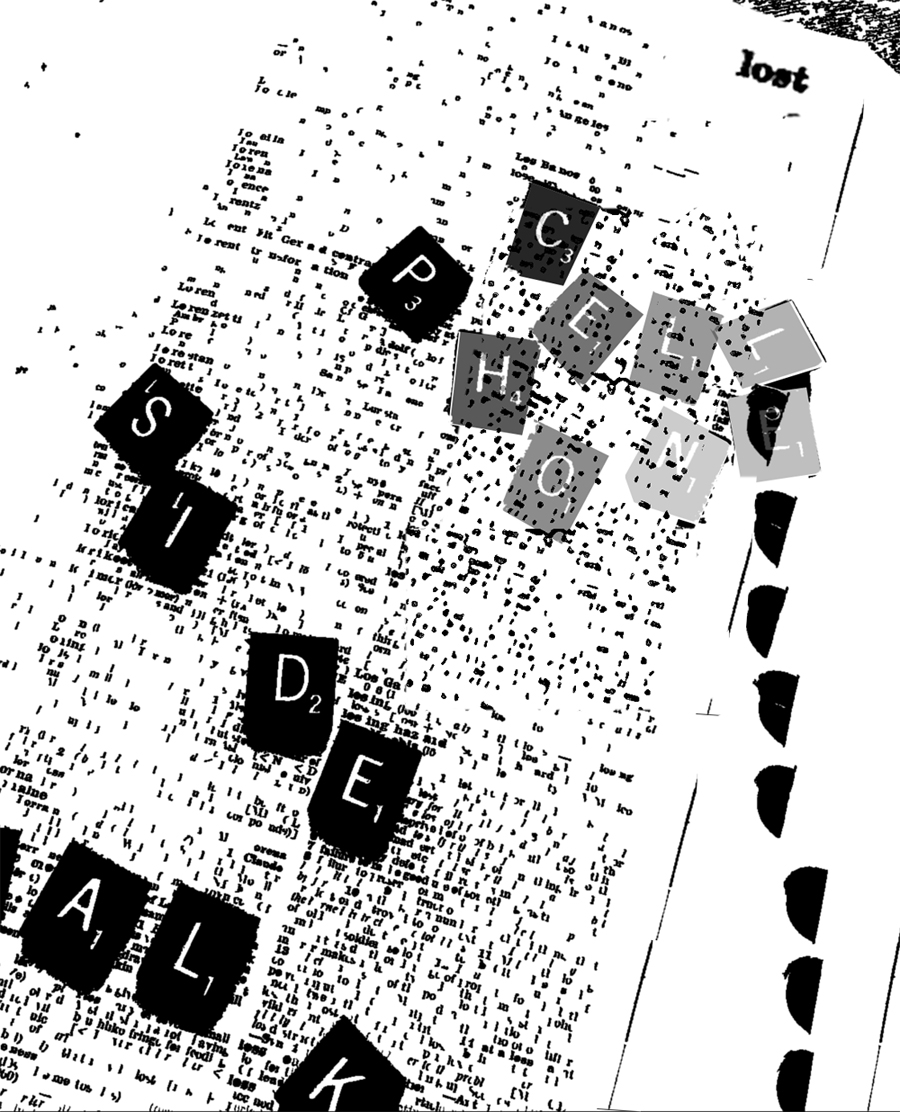 art by Gay Degani |
Some people have had the idea to try to come up with replacements, but the new words just won't stick, as if this is not really a matter of words abandoning us, but of things that refuse to be named.
At some point we lost track of how many words have gone. There's no doubt anymore whether they have been vanishing from dictionaries as well—dictionaries are getting thinner. Other books are not getting thinner, but are merely developing empty spaces. I wonder how long it will be before they are filled with blank pages, every last one turned into a sketch pad, or a journal if there's anything left to write.
So far, we have managed to adapt. There are ways to describe almost anything. Sometimes I think about this game we used to play when I was a kid, where you tried to make your teammates guess a word without using a certain list of closely related words, like you would not be able to use the word "orange" if you were trying to make someone guess "carrot." When we lost the word for the color of the sky, I thought about how maybe playing that game was good practice. I can't remember the name of the game, but I don't think it's a vanished word. I think it's something I just forgot on my own.
The words that are gone are like hundreds of tiny phantom limbs. They feel constantly like they are on the tip of my tongue. The sensation reminds me of the way I felt during the final few months my lover and I spent together, like I always had a mouthful of words I could not form the right shape for no matter how many ways I tried to arrange my lips and my tongue and my teeth. It was like waking up on the very edge of remembering a dream, that feeling of being so goddamn close to something but still so far away it was useless, might as well have been on the other side of the universe.
Sometimes I wonder how many words have disappeared that I have not even noticed because they are words I seldom ever use. It would probably take me a long time to realize, for example, if "horticulture" or "uvula" or "bismuth" went away. Every once in a while I flip through the dictionary, just to remind myself of how much is still left.
The way we speak now: like we are always trying to explain things to visitors here who barely speak our language. We say: the clear smooth stuff that you look through to see outside if you are indoors. We say: the box with the moving pictures on it that we watch to forget real life. We say: the buildings we live in. The animals with feathers that can usually fly but sometimes cannot. The specific injury when you touch something too hot or stay too long in the sun. Sometimes I think it sounds like a kind of poetry, and other times I just think we all sound simple-minded and slow. We are all like visitors here now.
It didn't bother me when we lost the word for the metal things we ride in to get from one place to the next. But I cried when I realized we'd lost the name for the tiny dots of light you can see up in the sky in the nighttime. I can't explain why, but that was the only word I really mourned, a loss that ached like a small death.
I think about how my lover and I were always trying to find more words, as if language was the thing that could put us back together again. But maybe what we needed all along was to say less. When I think of him now, what I remember is not anything he ever said. I remember breathing into his neck, and the way I would slide my arms up inside of his jacket not for warmth but because I could never figure out how to feel close enough to him. What I felt was always a wanting—I wanted him even when I was with him, a longing lodged squarely beneath my breastbone, inside some dull-thumping muscle I used to have a name for. And I wonder sometimes what would happen now if I called him and said nothing at all, if it's possible somehow for the mere sound of my breath to release all those ghosts of words trapped inside my throat, to tell him all the things that have become unspeakable.
"http://www.smokelong.com/flash/angibeckerstevens31.asp
All content in SmokeLong Quarterly copyright 2003-2011 by its authors.
Angi Becker Stevens' stories have appeared in a variety of publications, including The Collagist, Pank, Monkeybicycle, Wigleaf, and Best of the Web 2010. She lives in Michigan and has one daughter, two partners, and a small assortment of oddly-sized pets.
Nominated for a Pushcart, Gay Degani has published in journals, anthologies, and her own collection, Pomegranate Stories. A list of her online writing can be found at Words in Place. Her artwork has been featured at Faraway Journal, 3 A.M, and Smokelong Quarterly. She’s a staff editor at SmokeLong and managing editor of EDF’s Flash Fiction Chronicles.
Sunday, February 27, 2011
But Not Necessarily For Kittens
Let me recount a beautiful but sad experience I had at 6:00 this morning. Since Gregory's illness has progressed, I have become a light sleeper. So this morning I was instantly aware that Gregory was awake. I couldn't tell if the noises he was making were laughter or crying.
"Are you OK?" I asked.
"No." he replied through his tears. "I miss her so. Do you know who I mean?"
I quickly thought of his mother, Helen, whose death anniversary is tomorrow. Maybe that is who he meant but our conversation took a different direction. Perhaps he was awake or just back from a dream. Either way I did not analyze.
"No, not my mother. My painting teacher. Nancy. I wish she would come back. I miss her so!" and he continued to whimper and sob. "Where is she?"
By now I was wide awake, on my elbow, holding his shoulders and we rocked. "She is in California at an art show. She'll be back. It will be OK. It will be Ok." And we rocked.
Tears began to run from my eyes, unasked and unannounced. It makes me so sad when he is sad. But I could only be there for him and lie by his sadness. Soon he calmed down, "I am OK now. Isn't that silly. I'm sorry."
"Don't apologize. No it isn't silly. I know you really miss Nancy. She'll be back soon."
I know how much he has been enjoying his new artistic endeavor painting with oils. I know how important his relationship with Nancy is. As she says, their time together needs no language and we seem to have a quiet ability to communicate, not necessarily with lots of words.
"Maybe I shouldn't say this but I have an idea for a piece. With all grays," he inserted into my thinking. Then, "Do you think I could take two or three pieces to the party?" he asked like a small boy would ask. He was referring to the Oscar Party we are going to tonight at Danny and David's. We have been doing this for some twenty years now.
"Perhaps that wouldn't be a good idea. We don't want to take the focus away from Danny and David. We could make a few smaller photographs of your paintings to carry in your wallet if you would like."
"That would be nice. This is so silly. I am sorry."
"Honey don't apologize. It's OK. Sometimes waking up from a dream can be difficult and strange."
"But not necessarily for kittens," he said as he petted our cat Mariah who was at his side, "Not necessarily for kittens."
"Are you OK?" I asked.
"No." he replied through his tears. "I miss her so. Do you know who I mean?"
I quickly thought of his mother, Helen, whose death anniversary is tomorrow. Maybe that is who he meant but our conversation took a different direction. Perhaps he was awake or just back from a dream. Either way I did not analyze.
"No, not my mother. My painting teacher. Nancy. I wish she would come back. I miss her so!" and he continued to whimper and sob. "Where is she?"
By now I was wide awake, on my elbow, holding his shoulders and we rocked. "She is in California at an art show. She'll be back. It will be OK. It will be Ok." And we rocked.
Tears began to run from my eyes, unasked and unannounced. It makes me so sad when he is sad. But I could only be there for him and lie by his sadness. Soon he calmed down, "I am OK now. Isn't that silly. I'm sorry."
"Don't apologize. No it isn't silly. I know you really miss Nancy. She'll be back soon."
I know how much he has been enjoying his new artistic endeavor painting with oils. I know how important his relationship with Nancy is. As she says, their time together needs no language and we seem to have a quiet ability to communicate, not necessarily with lots of words.
"Maybe I shouldn't say this but I have an idea for a piece. With all grays," he inserted into my thinking. Then, "Do you think I could take two or three pieces to the party?" he asked like a small boy would ask. He was referring to the Oscar Party we are going to tonight at Danny and David's. We have been doing this for some twenty years now.
"Perhaps that wouldn't be a good idea. We don't want to take the focus away from Danny and David. We could make a few smaller photographs of your paintings to carry in your wallet if you would like."
"That would be nice. This is so silly. I am sorry."
"Honey don't apologize. It's OK. Sometimes waking up from a dream can be difficult and strange."
"But not necessarily for kittens," he said as he petted our cat Mariah who was at his side, "Not necessarily for kittens."
Friday, February 25, 2011
It Becomes Easier as it Becomes Harder
I may have written about this before but I think it is worth my working through again.
It seems that the more Alzheimer's takes away from Gregory the easier it is for me to cope. I become more aware that he is unable to deal with certain situations: language is usually a problem now so I get used to it, he is confused more often than not so confusion is expected, disruptions in his routine always affect his ability to function so I mobilize and help him through the change, when he begins to get frustrated his level of frustration escalates and causes his abilities to decline so I do not give him tasks that would frustrate him, he is able to help less so I do more.
Gregory continues to be happy, content, and to enjoy his life. The difficulties come when I can't cope, get frustrated or angry, loose my temper, get short with him, forget that he is not the person he used to be when we met thirty five years ago. And since I am more aware of his inabilities, I expect less, ask less, do more and feel better. Sounds strange doesn't it?
It seems that the more Alzheimer's takes away from Gregory the easier it is for me to cope. I become more aware that he is unable to deal with certain situations: language is usually a problem now so I get used to it, he is confused more often than not so confusion is expected, disruptions in his routine always affect his ability to function so I mobilize and help him through the change, when he begins to get frustrated his level of frustration escalates and causes his abilities to decline so I do not give him tasks that would frustrate him, he is able to help less so I do more.
Gregory continues to be happy, content, and to enjoy his life. The difficulties come when I can't cope, get frustrated or angry, loose my temper, get short with him, forget that he is not the person he used to be when we met thirty five years ago. And since I am more aware of his inabilities, I expect less, ask less, do more and feel better. Sounds strange doesn't it?
Tuesday, February 22, 2011
Ragdale Revisited
Last year at about this time I was accepted for a two week residency in creative non-fiction writing at The Ragdale Foundation in Lake Forest. Acceptance was by competitive application and it was quite an honor to be accepted into their artist residency program. I have decided to republish my journal from that experience on my "michael a. horvich writes" BLOG. I can tell you, it was quite a respite from being an Alzheimer's Caregiver and I learned a lot about myself and who I am today. If you are interested in following my time at Ragdale follow this link. it will be posting between February 20, 2011 and the middle of March: RAGDALE REVISITED
Sunday, February 20, 2011
Words In Common
What do the following words have in common: closet, fork, pocket, water, guest room, scarf, underwear, sandwich, cell phone, pillow, dish washer?
For most people the words have nothing in common but in Gregory and my world, the commonality is that they are all associations with meaning that do not work regularly anymore. There are many other words in the list which come and go and sometimes disappear forever.
The problem is two fold: 1) A thought is expressed with words, 2) Words trigger thoughts. Recently, neither are functioning predictably. Up until now Gregory's struggled with being able to pull the words to match his thinking, now hearing words does not pull the correct or any image in his thinking.
First his use and recall of language began to suffer. He was not always able to put words to his thoughts. The thoughts and memories still existed, perhaps like a photograph in his mind, but he was not able to describe that picture with words (a skill which you I and I take for granted.) Sometimes between the two of us, we are able to attach words to the picture and sometimes the picture fades before that is accomplished.
Now other people's use of language doesn't always work for him. He is increasingly not making associations between the spoken word and its referent. That seems to tell me that the pictures my still exist but in his mind but now the pictures do not have the cognitive labels they used to.
In the past, when he would hear the word "glove" he would see the image "glove" in his mind even though he might not be able to say the word "glove" when he was thinking about one. Now those associations are taking a new turn and increasingly he cannot do either on his own. Sometimes when I say "glove" he thinks "scarf," sometimes he thinks "glove," and sometimes he thinks nothing. When he is looking for his gloves he does not know what to call them. When I ask where his gloves are, he does not know what that means.
Again, with the passage of time,we become more and more aware that the rules of this game not only are constantly shifting, but most often do not exist. Go figure that one out!
For most people the words have nothing in common but in Gregory and my world, the commonality is that they are all associations with meaning that do not work regularly anymore. There are many other words in the list which come and go and sometimes disappear forever.
The problem is two fold: 1) A thought is expressed with words, 2) Words trigger thoughts. Recently, neither are functioning predictably. Up until now Gregory's struggled with being able to pull the words to match his thinking, now hearing words does not pull the correct or any image in his thinking.
First his use and recall of language began to suffer. He was not always able to put words to his thoughts. The thoughts and memories still existed, perhaps like a photograph in his mind, but he was not able to describe that picture with words (a skill which you I and I take for granted.) Sometimes between the two of us, we are able to attach words to the picture and sometimes the picture fades before that is accomplished.
Now other people's use of language doesn't always work for him. He is increasingly not making associations between the spoken word and its referent. That seems to tell me that the pictures my still exist but in his mind but now the pictures do not have the cognitive labels they used to.
In the past, when he would hear the word "glove" he would see the image "glove" in his mind even though he might not be able to say the word "glove" when he was thinking about one. Now those associations are taking a new turn and increasingly he cannot do either on his own. Sometimes when I say "glove" he thinks "scarf," sometimes he thinks "glove," and sometimes he thinks nothing. When he is looking for his gloves he does not know what to call them. When I ask where his gloves are, he does not know what that means.
Again, with the passage of time,we become more and more aware that the rules of this game not only are constantly shifting, but most often do not exist. Go figure that one out!
"In The Table" & "On The Wall"
Last night Gregory and I were featured artists at Jan and Jake's "In The Table Gallery." Jan wrote a wonderful BLOG about the event and instead of trying to do the job as well as she did, I have posted her entry:
In the Table/ On the Wall


 Visit Michael’s Museum to find out more information about the upcoming opening at the Chicago Children’s Museum.
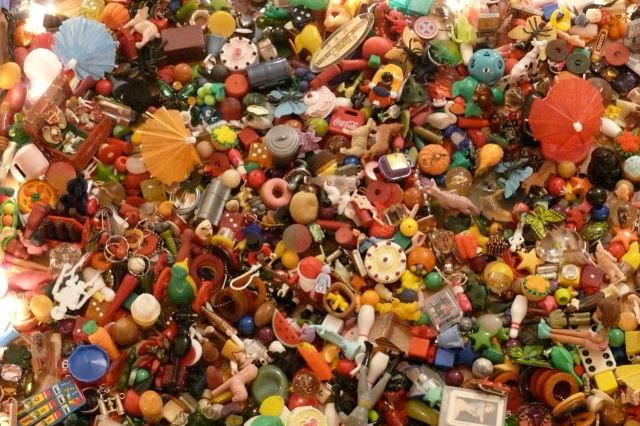
In a previous post, I described our new Amish built display table for our living room, which has allowed us to exhibit lots of items from our vast tchotchke collection. Playfully, but seriously, I suggested to my friend Michael that he have a show “in the table.” He has been collecting miniatures his entire life and now his collection, on permanent loan to the Chicago Children’s Museum (also in aprevious post), will open this May 13. But he is a consummate (and obsessive) collector and so has continued collecting since this donation. He would use the table.
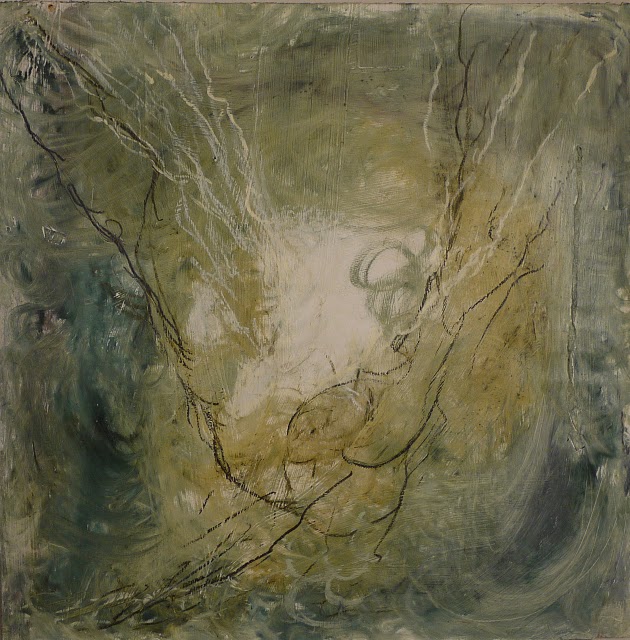
His partner, Gregory, who was diagnosed with early onset of Altzheimers 10 years ago, has begun to paint, so Michael suggested that Gregory show his paintings as well. He would be “on the wall.”
Michael and Greg created Artist Statements about their work. An excerpt from Michael’s:
I have been a collector all my life…Unlike my other artistic endeavors which are usually orderly and symmetrical, if not balanced, “In the Table: A Display of Collected Items” invites the viewer to visually inspect, discover, and make sense of a disorderly array of unrelated items. The only thing they have in common is that they are all small. The contents of the table may be rearranged periodically during the reception.My installation was inspired by a visit to The Menil Collection in Houston where I saw a show called Witness. In a small, dark, but carefully lit room, were cases displaying actual and reproduced items with which the Surrealists surrounded themselves in their studios.…What inspired me in particular was a glass top coffee table, placed on a platform in one corner of the Witness exhibit, which had belonged to Mrs. Menil. It contained in no particular order, a huge array of items, each more interesting than the next. Her purpose was to inspire her visitors, adults and children, to play, discover, question, and learn from the items in the table…The collector in me was moved and wanted to both play with and to own Mrs. Menil’s table collection.
An excerpt from Gregory’s statement:
When I met Nancy Rosen…there was an instant connection…[A]n amazingly prolific and talented oil painter, [she] has taken me under her wing as I begin to develop my latest art form, working with oils.The paintings are on Stonehenge paper that has been roughly gessoed. I begin each piece by studying the rough surface of the paper in silent contemplation until it “speaks” to me. Then I paint and do not stop, or look at the work from afar, until I am finished with the piece. I automatically know when to begin and when to end a piece…The ideas just seem to come from within, I know not where exactly.

hanging the show
As I cleaned the house for the opening, I cleaned with real intention. I have never done that before, that is, clean with intention. Thoughts and memories of my 32 year old friendship with Michael and Greg filled me as I mopped, dusted, and even painted two walls. My intention in the cleaning of the house was a mantra to build constructive energy in the space of our home and to demonstrate my sincere love for the both of them. The house was flooded with light.
Last night at the opening, the energy was high and palpable. A wonderful mix of people (35-40 guests): friends of Michael and Greg’s, some of our friends, some of our son’s friends (and his new girlfriend, I might add), mutual friends. Good synergy. Diverse conversations and lots of places to explore and have them. We converted our son’s old room into a guest room/ gallery of JB’s and my work. Our studios were open and in the library upstairs, people played the theremin.
Boosted by the champagne cordials and other adult beverages, Michael and Greg held court with engaged admirers and supporters. The evening felt busy and electrically-charged. It was a wonderful feeling to be able to play host and create opportunities for others to have attention around their creative endeavors. It was wonderful to have a house that, inspired by this task, so easily adapted and grew creatively in its capacity to hold the tangible visions of others.

Gregory's GREEN SCRIBBLES, 25"X25", Oil on Gessoed Stonehenge Paper

Gregory's SHADES OF GRAY, 25"X25", Oil on Gessoed Stonehenge Paper
JB’s closeup photo of “in the table:”
 Visit Michael’s Museum to find out more information about the upcoming opening at the Chicago Children’s Museum.
Monday, February 14, 2011
Valentine's Day Part Two
Had a wonderful dinner at "The Pine Yard," a Chinese restaurant in our neighborhood that has delicious food. Now a movie and then our "Chocolate Volcanos" with vanilla ice cream.
Gregory was delighted with the red satin heart filled with Godiva Chocolates. If I behave he might let me have one or two.
The card he bought for me is touching. He was very pleased with himself and his selection. The card portrays two adorable rabbits, or are they mice, (G seems to think they are Bunnies) as seen from behind as they sit on a swing bench attached to the branch of a tree. They are arm in arm and leaning their heads together watching a sunset. The swing is next to their home, the same tree with its branch holding the swing. The colors are warm and soft and you can tell that love is in the air. The greeting inside says, "Your marriage is a true inspiration. Happy Anniversary. It is signed Greopry.
With the tear in my eye, can I tell you the card is beautiful, the sentiment is beautiful, my Gregory is beautiful.

Gregory was delighted with the red satin heart filled with Godiva Chocolates. If I behave he might let me have one or two.
The card he bought for me is touching. He was very pleased with himself and his selection. The card portrays two adorable rabbits, or are they mice, (G seems to think they are Bunnies) as seen from behind as they sit on a swing bench attached to the branch of a tree. They are arm in arm and leaning their heads together watching a sunset. The swing is next to their home, the same tree with its branch holding the swing. The colors are warm and soft and you can tell that love is in the air. The greeting inside says, "Your marriage is a true inspiration. Happy Anniversary. It is signed Greopry.
With the tear in my eye, can I tell you the card is beautiful, the sentiment is beautiful, my Gregory is beautiful.

Not All of One Part: In Four Acts with One Intermission
This has been a new adventure. Suddenly items with more than one part are causing Gregory some confusion. I will have to keep an eye on this.
ACT ONE:
Scene One: Book Mark
Scene Two: Book
Last night as we were finishing up reading, Gregory seemed to be having some trouble with his plastic, clip type bookmark. He asked me if I had another one like it and I asked why. "This just doesn't seem to work," he replied. Then after looking at the bookmark, this way and that, he said, "This may seem foolish, but I do not know how to make this work."
I demonstrated, two times on my book but and he still didn't get it. Then he realized that the reason he didn't understand how to use the bookmark is that he had put his book away and the bookmark by itself didn't make sense. Once he had his book in hand again, he was on the track.
ACT TWO:
Scene One: Electric Kettle
Scene Two: Electric Kettle Base
This morning a similar event took place. He came into the bedroom where I was working on my computer and while he couldn't explain in detail, he said something was wrong in the kitchen. I followed him in and he pointed to the electric tea kettle and said, "It doesn't seem to be working. I have the water but."
He had filled the kettle with water but it wasn't heating up. The reason it wasn't heating up is that he had placed the kettle on the counter next to the base but not ON the base. Obvious to me but not to him. Once he realized that one needed the water in the kettle AND the kettle needed to be on the base to heat the water, he was back on track.
INTERMISSION:
You may have noticed that a lot of these recent BLOG entries have been describing new things that have been going wrong, misfiring, short circuiting, causing me anguish. I feel like I have been spending a lot of time detailing Gregory's progression (regression?) and that the BLOG may seem like so much complaining. But things seem to be progressing (regressing?) at a faster rate. Hopefully it will slow down after a while.
Certainly the BLOG is one way of my dealing with our life and also a way of sharing our life with people who care and need to know. Right now, however, I am not sure how helpful this is being to other people dealing with Alzheimer's and other dementias. Let me just say that perhaps my experiences will help if only to show you that you are not alone. Hang in there. It will get worse. You will get better at dealing with the details.
ACT THREE:
Scene One: Water
Scene Two: Glass
Just now Gregory is a little distracted because the plumber is working on the kitchen sink. He asked me, pointing to the bathroom, "Can I get water in here?"
"Yes," I replied. He stood in the bathroom doorway not knowing what to do. His hand kept taking the shape of holding a glass but he looked around getting more confused. He left the room and paused in the hallway.
"Do you need a glass?" I asked.
"Yes."
"Here use this one." He came back taking the glass I had on my desk which was half filled with water. He wanted to fill it with more water but already forgot that he could get water in the bathroom so he headed for the kitchen where the plumber was working. I called him back and said, "You can get water in there," pointing towards the bathroom.
"Right," he said. Once in the bathroom however he did not know how to 'get water." It took him a real conscientious effort, thinking out loud, and finally he figured it out saying, "Of course!"
ACT FOUR:
Scene One: Helping
Scene Two: Typing
Scene Three: Worrying
Meanwhile I am being distracted helping Gregory, typing this BLOG, and wondering how much this plumber visit is going to cost me. Life goes on.
CURTAIN
ACT ONE:
Scene One: Book Mark
Scene Two: Book
Last night as we were finishing up reading, Gregory seemed to be having some trouble with his plastic, clip type bookmark. He asked me if I had another one like it and I asked why. "This just doesn't seem to work," he replied. Then after looking at the bookmark, this way and that, he said, "This may seem foolish, but I do not know how to make this work."
I demonstrated, two times on my book but and he still didn't get it. Then he realized that the reason he didn't understand how to use the bookmark is that he had put his book away and the bookmark by itself didn't make sense. Once he had his book in hand again, he was on the track.
ACT TWO:
Scene One: Electric Kettle
Scene Two: Electric Kettle Base
This morning a similar event took place. He came into the bedroom where I was working on my computer and while he couldn't explain in detail, he said something was wrong in the kitchen. I followed him in and he pointed to the electric tea kettle and said, "It doesn't seem to be working. I have the water but."
He had filled the kettle with water but it wasn't heating up. The reason it wasn't heating up is that he had placed the kettle on the counter next to the base but not ON the base. Obvious to me but not to him. Once he realized that one needed the water in the kettle AND the kettle needed to be on the base to heat the water, he was back on track.
INTERMISSION:
You may have noticed that a lot of these recent BLOG entries have been describing new things that have been going wrong, misfiring, short circuiting, causing me anguish. I feel like I have been spending a lot of time detailing Gregory's progression (regression?) and that the BLOG may seem like so much complaining. But things seem to be progressing (regressing?) at a faster rate. Hopefully it will slow down after a while.
Certainly the BLOG is one way of my dealing with our life and also a way of sharing our life with people who care and need to know. Right now, however, I am not sure how helpful this is being to other people dealing with Alzheimer's and other dementias. Let me just say that perhaps my experiences will help if only to show you that you are not alone. Hang in there. It will get worse. You will get better at dealing with the details.
ACT THREE:
Scene One: Water
Scene Two: Glass
Just now Gregory is a little distracted because the plumber is working on the kitchen sink. He asked me, pointing to the bathroom, "Can I get water in here?"
"Yes," I replied. He stood in the bathroom doorway not knowing what to do. His hand kept taking the shape of holding a glass but he looked around getting more confused. He left the room and paused in the hallway.
"Do you need a glass?" I asked.
"Yes."
"Here use this one." He came back taking the glass I had on my desk which was half filled with water. He wanted to fill it with more water but already forgot that he could get water in the bathroom so he headed for the kitchen where the plumber was working. I called him back and said, "You can get water in there," pointing towards the bathroom.
"Right," he said. Once in the bathroom however he did not know how to 'get water." It took him a real conscientious effort, thinking out loud, and finally he figured it out saying, "Of course!"
ACT FOUR:
Scene One: Helping
Scene Two: Typing
Scene Three: Worrying
Meanwhile I am being distracted helping Gregory, typing this BLOG, and wondering how much this plumber visit is going to cost me. Life goes on.
CURTAIN
Sunday, February 13, 2011
Rainer Maria Rilke
For one human being to love another is
perhaps the most difficult task of all
the epitome, the ultimate test.
It is that striving for which all other striving
is merely preparation.
René Karl Wilhelm Johann Josef Maria Rilke (1875 – 1926), better known as Rainer Maria Rilke, was a Bohemian Austian poet.
perhaps the most difficult task of all
the epitome, the ultimate test.
It is that striving for which all other striving
is merely preparation.
René Karl Wilhelm Johann Josef Maria Rilke (1875 – 1926), better known as Rainer Maria Rilke, was a Bohemian Austian poet.
Saturday, February 12, 2011
Mortality
Routine takes the edge off of mortality.
This line taken from "Nixon in China," the opera we just saw at Met at the Movies, seems to ring so true for my current life. Even with all the wonderful things happening with Michael's Museum, being in Carmen at The Lyric Opera of Chicago, waiting to hear from the publisher about my manuscript, so much to be grateful for. Ironic.
Composer-John Adams, Director-Peter Sellars
This line taken from "Nixon in China," the opera we just saw at Met at the Movies, seems to ring so true for my current life. Even with all the wonderful things happening with Michael's Museum, being in Carmen at The Lyric Opera of Chicago, waiting to hear from the publisher about my manuscript, so much to be grateful for. Ironic.
Composer-John Adams, Director-Peter Sellars
Friday, February 11, 2011
Valentine's Day
Ouch. This one was hard. You know how some people say, "If you have to be reminded it doesn't count?" Well I have decided that it does count. For Valentine's Day I bought Gregory a beautiful satin heart filled with Godiva chocolates. I didn't want him to feel badly that I remembered him for Valentine's Day and that he didn't remember me. Also I wanted to be remembered so I began to remind him a week early. "You have seven days to get me something for Valentine's Day." 6 ... 5 ... 4 ... 3... etc.
Today, he went out for his usual afternoon walk and without my reminding he stopped at the Barnes and Nobel and bought me a Valentine's Day Card (at least I think that is what he got, I will not know for sure until Monday.) I suggested he sign it and we could put it on the counter until Monday. He did not know what I meant. "It has been such a long time since I got anyone a card!" Then he got overwhelmed and began crying at not knowing what to do. While he sat on the bench, I held his head in my arms and we rocked together. When he calmed down we set about accomplishing this difficult adventure together.
He kept trying to take the card out of its bag but I explained, "I don't want to see it until Valentine's Day." I explained that one puts the name of the person on the envelope and writes a message inside the card. Based on the look on his face, I was not sure if he knew any of the words or concepts. I waited patiently while he did some heavy thinking, "I think I just want what's written inside." Maybe he did understand what I had said.
That was good enough for me so I sat him down at my computer desk, gave him a red pen, reached into the bag without looking (saying "I'm not looking.") and gave him the envelope on which to write my name.
"This is going to be hard," he said so I took a post-it note and wrote my name on it. With some coaching he was 80% able to copy my name from the post-it onto the envelope. Next I opened the card (still not looking but with a little peeking so I could see where he should sign his name and pointed. This time I wrote his name on a post-it so he could copy. It was more difficult for him copying his own name.
Finally we were finished, he sealed the envelope (with my prompting) and we put it on the counter with my gift for him to wait until Monday. We will go out for dinner and then after watching a movie at home I am making Fudge Brownie Volcanoes (the kind you warm up in the microwave so the center fudge melts and runs on cutting) with Ice Cream. It will be good.
Today, he went out for his usual afternoon walk and without my reminding he stopped at the Barnes and Nobel and bought me a Valentine's Day Card (at least I think that is what he got, I will not know for sure until Monday.) I suggested he sign it and we could put it on the counter until Monday. He did not know what I meant. "It has been such a long time since I got anyone a card!" Then he got overwhelmed and began crying at not knowing what to do. While he sat on the bench, I held his head in my arms and we rocked together. When he calmed down we set about accomplishing this difficult adventure together.
He kept trying to take the card out of its bag but I explained, "I don't want to see it until Valentine's Day." I explained that one puts the name of the person on the envelope and writes a message inside the card. Based on the look on his face, I was not sure if he knew any of the words or concepts. I waited patiently while he did some heavy thinking, "I think I just want what's written inside." Maybe he did understand what I had said.
That was good enough for me so I sat him down at my computer desk, gave him a red pen, reached into the bag without looking (saying "I'm not looking.") and gave him the envelope on which to write my name.
"This is going to be hard," he said so I took a post-it note and wrote my name on it. With some coaching he was 80% able to copy my name from the post-it onto the envelope. Next I opened the card (still not looking but with a little peeking so I could see where he should sign his name and pointed. This time I wrote his name on a post-it so he could copy. It was more difficult for him copying his own name.
Finally we were finished, he sealed the envelope (with my prompting) and we put it on the counter with my gift for him to wait until Monday. We will go out for dinner and then after watching a movie at home I am making Fudge Brownie Volcanoes (the kind you warm up in the microwave so the center fudge melts and runs on cutting) with Ice Cream. It will be good.
Remembering the Forgetting
Sometimes forgetting is good. Like this morning when Gregory asked me, "It needs to be fixed?"
I didn't remember that last night the TV and Cable Box were not communicating. He stood by my computer as I stopped working to listen while he tried to compose his thoughts.
I finally asked, "Can you show me?"
He said, "Yes" and I followed him into the TV room where he stood trying to remember what he wanted to tell me about.
Then I remembered the TV and all was well. "The TV?"
"Yes," he glowed!
I thanked him for reminding me and he felt good. All was well ... including my smiling loving face and my breaking heart.
I didn't remember that last night the TV and Cable Box were not communicating. He stood by my computer as I stopped working to listen while he tried to compose his thoughts.
I finally asked, "Can you show me?"
He said, "Yes" and I followed him into the TV room where he stood trying to remember what he wanted to tell me about.
Then I remembered the TV and all was well. "The TV?"
"Yes," he glowed!
I thanked him for reminding me and he felt good. All was well ... including my smiling loving face and my breaking heart.
Monday, February 7, 2011
Reality Test
Most often I try to anticipate Gregory's needs, especially as his language and communication abilities continue to disintegrate. Most often I am able to figure out what he wants to say or tell me. As I have written before, its those times that I cannot anticipate or guess that make for difficult interactions and therefore are emotionally heavy situations for both Gregory and me.
Another area of difficulty is Gregory's ability to make connections and associations. I will ask him to get me a new kitchen towel and he will not recognize word "towel." This has been happening more and more as his grasp of the meaning of any particular word continues to fail.
For example, as he is trying to ask me about where his gloves are, he will wiggle his hands but when I ask, "Are you looking for your gloves?" he will reply, "No." Even though it is his gloves he is looking for. Is it the disconnect of the word "No" or the word "Gloves." Sometimes that is clear to me and other times it is not.
Most difficult of all is when I feel that I have to "wait it out" and not help at all. Sometimes I feel the need to do a reality test to see exactly how much Gregory is going to be able to do. Last night I asked him, as I usually do, to set the table for dinner. He got the place mats and napkins done but forgot the silverware. He moved on to fill the water glasses.
He usually stands in front of the open refrigerator thinking about "what's missing." Then he will realize and shut the refrigerator, go to the cabinet, get out two glasses, and put them on the counter. Sometimes I will just say the word "glasses" and he will click in and proceed.
This time he stood in front of the open refrigerator for a long time. He looked over at where the empty glasses usually sit while waiting to be filled but it didn't help this time. Then he closed the refrigerator and opened the freezer. He pulled out the ice drawer and scooped out a handful of ice, turned towards the usual "where the glasses are waiting place" and stood, confused, hands cold with ice, not knowing what to do.
He looked at me several times and I soothingly replied, "I'm just being patient." Sometimes I will say, "I am just giving you space." This is to let him know that I am not upset or angry that he is confused.
Next he returned the ice to the drawer, closed it, and closed the freezer. He turned to me and said, "OK I give." I went to the cabinet hand handed him two glasses. He successfully took over from there. But what an ordeal. And watching the look on his face as he becomes increasingly confused (sometimes embarrassed, sometimes angry, sometimes just confused) is very painful for me.
Reality checks are no fun for me to suffer quietly and probably not easy for Gregory, but they are necessary so I can keep tabs on what he can do and what he cannot do with greater or lesser frequency. When it looks like the skill is really gone, I will not ask him to help with the skill or I will give a lot more support up front. For example, I am about to start handing him two glasses every time I ask him to get our dinner waters. Soon I'll have to put out the place mats, napkins, and silverware and hope he can figure out where it goes. Time will AND DOES tell!
Another area of difficulty is Gregory's ability to make connections and associations. I will ask him to get me a new kitchen towel and he will not recognize word "towel." This has been happening more and more as his grasp of the meaning of any particular word continues to fail.
For example, as he is trying to ask me about where his gloves are, he will wiggle his hands but when I ask, "Are you looking for your gloves?" he will reply, "No." Even though it is his gloves he is looking for. Is it the disconnect of the word "No" or the word "Gloves." Sometimes that is clear to me and other times it is not.
Most difficult of all is when I feel that I have to "wait it out" and not help at all. Sometimes I feel the need to do a reality test to see exactly how much Gregory is going to be able to do. Last night I asked him, as I usually do, to set the table for dinner. He got the place mats and napkins done but forgot the silverware. He moved on to fill the water glasses.
He usually stands in front of the open refrigerator thinking about "what's missing." Then he will realize and shut the refrigerator, go to the cabinet, get out two glasses, and put them on the counter. Sometimes I will just say the word "glasses" and he will click in and proceed.
This time he stood in front of the open refrigerator for a long time. He looked over at where the empty glasses usually sit while waiting to be filled but it didn't help this time. Then he closed the refrigerator and opened the freezer. He pulled out the ice drawer and scooped out a handful of ice, turned towards the usual "where the glasses are waiting place" and stood, confused, hands cold with ice, not knowing what to do.
He looked at me several times and I soothingly replied, "I'm just being patient." Sometimes I will say, "I am just giving you space." This is to let him know that I am not upset or angry that he is confused.
Next he returned the ice to the drawer, closed it, and closed the freezer. He turned to me and said, "OK I give." I went to the cabinet hand handed him two glasses. He successfully took over from there. But what an ordeal. And watching the look on his face as he becomes increasingly confused (sometimes embarrassed, sometimes angry, sometimes just confused) is very painful for me.
Reality checks are no fun for me to suffer quietly and probably not easy for Gregory, but they are necessary so I can keep tabs on what he can do and what he cannot do with greater or lesser frequency. When it looks like the skill is really gone, I will not ask him to help with the skill or I will give a lot more support up front. For example, I am about to start handing him two glasses every time I ask him to get our dinner waters. Soon I'll have to put out the place mats, napkins, and silverware and hope he can figure out where it goes. Time will AND DOES tell!
Saturday, February 5, 2011
No Day But Today (From Rent)
Another song lyrics that put things in perspective when I am feeling down. Makes me cry. Makes me feel better. I love him and he loves me!
NO DAY BUT TODAY
From "Rent"
As Sung by Idena Menzel
There’s only us, there’s only this
Forget, regret, or life is yours to miss
No other path, no other way
No day but today
There’s only us, only tonight
We must let go to know what’s right
No other road, No other way
No day but today
I can’t control my destiny
I trust my soul, my only goal
Is just to be
There’s only now, there’s only here
Give in to love or live in fear
No other path, No other way
No day but today
There’s only us, There’s only this
Forget, regret, or life is your’s to miss
No other road, no other way
No day but today
No day but today
(No day but today)
No day but today
(No day but today)
No day but today
(No day but today)
No day but today
NO DAY BUT TODAY
From "Rent"
As Sung by Idena Menzel
There’s only us, there’s only this
Forget, regret, or life is yours to miss
No other path, no other way
No day but today
There’s only us, only tonight
We must let go to know what’s right
No other road, No other way
No day but today
I can’t control my destiny
I trust my soul, my only goal
Is just to be
There’s only now, there’s only here
Give in to love or live in fear
No other path, No other way
No day but today
There’s only us, There’s only this
Forget, regret, or life is your’s to miss
No other road, no other way
No day but today
No day but today
(No day but today)
No day but today
(No day but today)
No day but today
(No day but today)
No day but today
Subscribe to:
Posts (Atom)