FOR GREGORY. He was not a VICTIM of ALZHEIMER'S DISEASE, he was a HERO!

PLEASE NOTE: Even though this blog is now dormant there are many useful, insightful posts. Scroll back from the end or forward from the beginning. Also, check out my writer's blog. Periodically I will add posts here if they provide additional information about living well with Dementia / Alzheimer's Disease.

Showing posts with label Yoga. Show all posts

Tuesday, December 8, 2015

My Guru

Guru: Guru is a Sanskrit term that connotes someone who is a "teacher, guide or master" of certain knowledge. In pan-Indian traditions, guru is someone more than a teacher, traditionally a reverential figure to the student, with the guru serving as a "counselor, who helps mold values, shares experiential knowledge as much as literal knowledge, an exemplar in life, an inspirational source and who helps in the spiritual evolution of a student."

I call Corinne "My Guru" and she always demurs, but I insist. She has done so much for me, through her yoga and Yoga Nidra classes, in helping me find peace during a time that was and is chaotic, stressful, emotional, frightening, frustrating, and I could go on. I am referring  to Gregory and my journey with Dementia/ Alzheimer's followed by his death, two months ago on October 4th.

Over the years, I studied world religions, searched deeply into my own Judaism, thought about Christianity, read the philosophies of great men, yet never found a path to finding peace, a way to get away from my problems, a way to cope with my sorrow and lonliness. Meditation and Corinne's classes helped me find that peace within myself and furthering my studies of Buddhism seemed to be the platform that enabled me to find that path.

Meditation and Yoga Nidra and Corinne have also helped me understand, deal with, and welcome in Gregory's death and my grieving. The current class I am taking from Corinne is called: "Yoga of Loss and Grieving."

If you have read my posts about session two and four, you will be familiar with one's "Inner Resource." Click here to read session 2's post. Click here to read session 4's post. (Both open in a new window.)

Based on my post about session 4, this is the e-mail I received from Corinne. You will see why I call her my Guru! Find out more about Corinne on her website. (Opens in a new window.)

Hi Michael – 

Thank you for sending along this post. I read it last night, and woke up thinking about it this morning. 

One thought I have is perhaps to develop an additional way to connect with Inner Resource - remembering that any visualization we use is to connect with the felt-sense of our own wholeness. Our true nature has never been harmed, has never suffered, has never caused suffering, is not lacking and has always been complete. This feeling is often described as peaceful, calm, safe, secure, strong, grounded, etc. Everyone has different language to describe this feeling.  Any imagery we use is not the feeling, rather a vehicle or pathway to experiencing it. The feeling is what we are connecting with, using this very human way to do it (our imagination).

My thought is that it could be helpful to have another way to connect with your Inner Resource that is more neutral/less charged.  Then you can reconnect with your True Nature/Inner Light in a way that is more direct, rather than through Gregory.  You can have more than one way of connecting with your Inner Resource, and you could decide which to use at different times. 

This may take some exploration, which I'd be happy to do with you. Therapy would also be a wonderful place to explore this. I'd also be happy to talk with your therapist at any time, I'm doing this more and more. Whatever is helpful for you in this mysterious, unfolding journey.

xo Corinne

This is my reply to Corinne:

Corinne, 
Hi. Thanks so much for your thoughtful e-mail. I think you are correct in your observations and as I was reading the e-mail, I instantly re-discovered another path to an Inner Resource. Many, many years ago when I was helping my fifth grade students through “Guided Visualizations,” I created for myself a personal waterfall oasis. It is a calm, peaceful place located in a lush, green rain forest. I would at times stand under the tepid water the of falls to wash away problems, fears, illness, etc. I think I will be able to use that as a way of “unloading” my current Inner Resource. Depending on what I am seeking, I can choose which one to go to in time of need. Thanks again my Guru!

Michael

Tuesday, November 17, 2015

Grief and Loss

Started a new yoga series with my "guru" Corinne Peterson, Click here to visit her site. (Opens in a new window.)

The ten session class was scheduled to run through the holiday season beginning two weeks before Thanksgiving and ending after the New Year. Corinne did it this way because for people dealing with grief and loss, the holidays are most often a very difficult time.

The first session consisted of sharing a little about why each of us were there, Yoga stretching and movement, focus on breathing, and a thirty minute guided meditation.

The energy in the room was heavy as people shared their reasons for signing up for the series and what they hoped to gain by attending. The the sense of community began to build almost immediately and as we moved into the Yoga and Meditation, I could almost sense, if only a tiny bit, the beginnings of healing for many of us there or at least leaving the grief behind for a brief period of time.

When asked to establish an intention for the session's practice, I looked into myself and came up with, "You need to re-establish you connection to JOY!" When I spent time at Lieberman visiting Gregory and the other residents I always felt so much joy at my ability to bring joy to others.

I felt joy helping a resident put the cloth napkin around their neck or  getting them another glass of juice or helping to cut up the food into bite size pieces. I felt joy at providing treats of chocolate, licorice, cookies, and more to Gregory and to the staff who dropped by his room to help or just to say "Hi" and grab a mini Butterfinger or Babe Ruth.

I felt joy during the resident's arts and crafts activities or the sing-alongs or the rhythm bands. I felt joy kissing Gregory or telling Martha, "I love you!" with her giggling and saying "You probably tell that to all the girls!" I felt joy clapping along to the Sunday Concert performers or helping to pass out cookies and juice to the attendees.

While I still feel joy in my daily life, the dosage is not large enough. So I need to think about how I can put more back into my life. Thank you Corinne. See you next session!

Friday, May 30, 2014

Panchamaya Kosha Session Four

I am including this "michael a horvich writes" post on the "michael a horvich cares about alzheimer's" BLOG. While I have decided to separate my personal writing from my Alzheimer's writing, this post really related to both as it discusses what I have termed "Acceptable Grief." Read on:

Interesting Yoga session today if only because earlier in the day my psychologist and I did a hypnosis session which was very much like a Yoga Nidra Mindful Meditation Session.

Then this evening, in quick summary, we breathed, stretched, focused, and meditated. A lot of attention to self and growth today!

In quick review, as the sessions have taken place we have moved from:
1) The Physical Body (using yoga movements) to
2) The Energy Body (using breath work) to
3) The Mental-Emotional Body (using the tool of sound/chant)  and this evening
4) The Wisdom Body (using the tool of meditation.)

This level of the Panchamaya Kosha deals with personality, character, and our beliefs about ourselves and the world around us. We alternated breath work with stretching work with meditation and cycled through these several times before doing the final Yoga Nidra rest.

During the Yoga Nidra meditation, when dealing with beliefs, my "voices" gave me the concept of "Acceptable Grief."

When in deep meditation, most times my mind quiets enough for me to be able to get in touch with deeper thoughts and ideas.

They present themselves in "understandings" or "images" rather than words or text. I refer to these as "my voices."

Then in these BLOG posts, I have to try to interpret what I "felt" into what I "thought."

Acceptable Grief.

grief |grēfnoundeep sorrow, esp. that caused by someone's death: she was overcome with grief. To this definition, I would add a great sense of loss. 

Obviously my concept of Acceptable Grief applies to the path that Gregory has been traveling with Alzheimer's Disease and on which I have chosen to accompany him. We both have been through so much over the last ten years and such quick change over the last four and a half months.

I find that while I still grieve for the loss of my lover, best friend, soul mate, and life companion, I am at peace with our current situation. He is being well taken care of at Lieberman, I am continuing to revitalize my life, and we both are doing well. 

When I am with Gregory I am able to be in the "Here and Now" as he is. Mine by choice, his by circumstances. I try not to think about our past or our future when I am with him.

When I am home I try to be in the "Here and Now" as well and I try not to think about  our past or Gregory in is situation.

For the most part, Gregory is comfortable, content, and happy. For the most part, I am filled with joy, happiness, and contentment.

But the Grief is always with me and now and then surfaces. When it does I pay it attention, cry if I need to, and in some ways embrace it. The concept of Grief not only includes the sorrow but also the joy in Gregory's and my situation. We are both in a good place. I would not have chosen it this way, but none-the-less, we are both in a good place. And that is acceptable. Thus, Acceptable Grief.

Saturday, May 10, 2014

Panchamaya Kosha Session One

I will post this just as a reminder. The writing I will be doing about my Yoga experiences, and the regaining of my Personal Self as distinguished from my Alzheimer's Self will now take place at http://mhorvich.blogspot.com

Here, in case you want to follow is the first session write up. Future ones will be at the new location.

Thanks and Namaste,
Michael

After discussing the model and its levels we began our Yoga session. Corinne demonstrated the various stretching and activities in "floor position" and in "chair position." Most of the ones I did were on a chair as I am so out of shape, recently had a bad case of Vertigo, and my back and hips have been bothering me. (This is not a poor me but information by way of your understanding the session.)

As the stretches and exercises progressed I found myself becoming more and more limber and finally ended up moving to floor style. I do not think that I have been as aware of my body in a long time (if ever) then when we were going through the stretches/exercises in this mindful way.

After the stretches/exercises we did a brief Yoga Nidra meditation mainly doing a "body scan" where Corinne led us through a mindful look at our bod, from the top of our head to the tips of our toes, in relation to breathing, the "inside" of it and the "outside" of it.

When I first started meditation classes I would say that many people think Yoga is physical stretching and exercising when it is really a way to calm and quiet the body so as to be better able to meditate.

While that is still true, I am afraid that I discounted Yoga too much. In this one short session, I became so aware of my body and its relation to the space around and the space inside that I now understand better the relationship between the physical and how it supports the mindful meditation.

I have continued to become more aware of how breathing relates to meditation, my study of Buddhism, and my emotions and sure enough here it shows up again in Yoga. I am excited about these sessions and look forward to the next ones to see what they will bring.

I might mention here that I have known for a while that I am very physically out of shape and needed to do something about it. The message hit home when I took myself to the emergency room with the Vertigo attack. It scared me. I thought my blood pressure had gone sky high (when it really was only registering the distress of my body with the Vertigo.) But the scare was enough for me to decide that thinking about doing something does NOT count as DOING something.

I surprised me with my quick actions: 1) Began discussing weight loss and made goals with my Psychologist, 2) Renewed my membership at LA Fitness, 3) Committed to a year of personal training at LA Fitness, 4) Began my weight loss program by weighing in and beginning a log of everything that I ate, 5) Beginning a six week Yoga Kosha session with Corinne.

I am airing my laundry here because by talking about it and by processing it, I think I will be able to try harder to succeed with this program of regaining my health. I DO NOT WANT TO BE OR FUNCTION LIKE AN OLD MAN, EVEN THOUGH I AM AN OLD MAN!

Also, as a reminder, this is being posted on my writers BLOG because I need to move on and separate my Alzheimer's Life from my Personal Life. No less love for Gregory but he is now safely ensconced and embraced. I need to do the same for myself.


Friday, May 9, 2014

Panchamaya Model

The Panchamaya Model is an ancient model of Yoga and Mindful Meditation that is the focus of a six week session that I am taking. The instructor, teacher, guide, guru, new friend is Corinne Peterson. 

You may remember a number of postings in the past when I was taking her Yoga Nidra classes. Yoga Nidra has helped so much, especially is dealing with Gregory and my journey with Alzheimer's, and I am grateful to Corinne for the great gift she has given to me.

Now that Gregory is lovingly ensconced and embraced by The Lieberman Center, it is time for me to focus on me. Slowly I have been regaining my sense of independence, relationships, emotions, life activities, and life purpose. What I know, however, is that I have let my physical body go to wreck due to lack of sleep, emotional disturbances, stress, lack of exercise, and comfort eating.

While most has calmed down since Gregory moved into Lieberman in January, the "body" is still out of control. Overweight. Huge belly (comparatively.) Achy joints especially knees and hips. Back pain. Little exercise. Little stamina. Loss of muscular strength. Shortness of breath. (How is that for being honest as I wash my laundry in front of the world?) 

I decided that it was time to take these "warning signals" to heart (literally) and do something about it. This is where I have started: 1) Focus on weight loss with my therapist, 2) Renewed LA Fitness gym membership, 3) Committed to a year with a personal trainer, 4) Am taking Corinne's Yoga session, 5) Have begun eating better.

My guess is that you will begin to see these themes show up in my writing. P.S. I have also decided to try to revitalize my writer's BLOG so I will be posting this type of personal grown at michael a horvich writes. I will repost this there and then continue it only on that site. So if you are interested in following:


• • • • •

The following provides a brief overview of the Yoga model which I will be working with over the next six weeks. Tomorrow I will write about my experiences with the first session.

Pancha Maya Kosha Model: Yoga Therapy and the Five Koshas
(http://yogauonline.com)
Yoga offers such a broad range of healing benefits, because it works holistically on the level of our whole being, not just the physical body. According to yoga philosophy, we are not just our physical body or mind, we are holistic, multi-dimensional beings made up by many different, interactive levels.
In the yoga framework, these levels are referred to as the five sheaths of our being, or the Five Koshas. To understand the Five Koshas and the role they play in yoga therapy, it's easiest to think of the Koshas as a series of Russian dolls, each embedded within the others. Starting from the outermost layer and moving towards the core, the Five Koshas proceed from outer to inner in greater and greater levels of subtlety:
Annamayakosha-The Physical body. This sheath represents the physical body, the 'regular' gross expression of our body that we can see, touch and feel. The Sanskrit word Anna means food, and the word mayameans appearance. This is the sheath of food, nourished by and created by our daily intake of food. TheAnnamayakosha is our physical body, the most familiar aspect of our being. As we practice yoga asanas, the physical body is the starting point of our experience.
Pranamayakosha-The Energy body. According to yoga therapy traditions, this is the second layer of our being.Prana means energy, but not energy in the usual Western meaning of the word. Rather, prana is the life-force, the vital energy which flows through and enlivens all our physical systems. The breath is the most physical expression of prana, and prana is closely related to the breath. Breath awareness and breathing practices, calledpranayama, increase and facilitate the flow of prana in the body and balance the flow of the life force to all the physical systems.
Manamayakosha-The Mental-Emotional body. Manasmeans mind, and the Manamayakosha is the layer of our being expressed as mind, emotions, and feelings. These are the mental faculties with which we absorb, process, and interpret input from our life (presented through the senses of the physical body). It is like a supervisor in a factory, which unfortunately often mistakenly takes on the role as manager.
Vijnanamayakosha-The Wisdom body. The fourth Kosha is considered part of the subtle body. Vijnana means knowing, and this sheath represents the higher mind, the faculty of wisdom, which lies underneath the processing, thinking, reactive mind. This is the level of our being, that has the higher wisdom to guide us through life and lead us to higher and higher levels of truth and integration. It represents the reflective aspects of our consciousness, which allow us to experience a deeper insight into ourselves and the world around us.
Anandamayakosha-The Bliss body. This is the fifth and final sheath of our being. Ananda means bliss, not bliss in the sense of emotions, such as happiness or pleasure, but an expanded, unbounded experience of reality. The ancients viewed the experience of the Bliss body as an experience of the deepest level of our being, an unbounded, blissful state of peace, joy, and love.
The Koshas are viewed as different, beautiful manifestations of our essential universal nature. According to yoga philosophy, this is known as Atman-the unbounded, universal Oneness of all that exists.
In practice, how do the different levels of our being interact? Take the example of depression. When we are depressed, we cannot help but slouch, rounding our shoulders and dropping our head forward Our breath becomes shallow and more restrained. In this way, our psychological mood, associated with our mental-emotional body (manamayakosha), affects our physical body (annamayakosha), as well as our breath and energy body (pranamayakosha).
In a yoga therapy practice, we begin to bring greater integration to the physical body with yoga asanas and to the breath body with yogic breathing or pranayamaAs the flow of vital energy is freed up in the physical body and breath body, this in turn creates greater vitality and integration in our mental-emotional body. This is why many people find that practicing yoga for depression often improves their mood and well-being considerably over time.
Of course, such deep-level changes don't happen overnight. Over the long term, however, yoga therapy can create permanent healing, because it helps bring greater integration to the deeper levels of our being, leading to increased balance, wisdom, and spiritual enrichment in all areas of life.

Tuesday, May 14, 2013

Mindfulness & Difficult Emotions


"Mindfulness & Difficult Emotions"
Tricycle: The Buddhist Review 
Spring 2013. Page 26 -28
By: Sharon Salzberg

I’ve heard some wonderful explanations of mindfulness. The writer and teacher Sylvia Boorstein calls it “awake attention to what is happening inside and outside so we can respond from a place of wisdom.” The Vietnamese Zen teacher and poet Thich Nhat Hanh says, “I like to define mindfulness as the energy that helps us to be there 100 percent. It is the energy of your true presence.” But my favorite definition comes from a fifth grader at Piedmont Avenue Elementary School in Oakland, California. 
In 2007, the school launched a pilot program that offered kids five weeks of mindfulness training from a coach who visited classrooms twice a week, leading 15-minute sessions on how to have “gentle breaths and still bodies.” The students trained their attention by focusing on their breath and noting the emotions that arose. The coach also asked them to cultivate compassion by reflecting—“taking a moment”—before lashing out at someone on the playground. “I was losing at baseball and I was about to throw a bat,” one boy told his class, according to The New York Times. “The mindfulness really helped.” 
The reporter asked another boy participating in the program to describe mindfulness. It’s “not hitting someone in the mouth,” he said. 
Giverny III
His answer is wise, wide, and deep. It illustrates one of the most important uses of mindfulness: helping us deal with difficult emotions. It suggests the possibility of finding the gap between a trigger event and our usual conditioned response to it, and using that pause to collect ourselves and change our response. And it demonstrates that we can learn to make better choices. 
“He doesn’t know what to do with his energy,” the student’s mother said at a parents’ meeting. He was, she explained, usually quick to strike out when he was confused or frustrated. But mindfulness training was changing that pattern. “One day after school he told me, ‘I’m taking a moment.’” 
This is just what the practice of mindfulness helps us remember. Working with emotions during our meditation sessions sharpens our ability to recognize a feeling just as it begins, not 15 consequential actions later. We can then go on to develop a more balanced relationship with it—neither letting it overwhelm us so we lash out rashly nor ignoring it because we’re afraid or ashamed of it. 
We learn a lot in that middle, mindful place. We begin to discover that, like the Oakland schoolboy, we can always take a moment—to re-center ourselves in our bodies, acknowledge what we’re feeling, spot our habitual reactions (whether that means erupting when we’re frustrated or silently sulking when we feel criticized), and perhaps decide on a different course of action. 
When I first began my meditative practice I was only 18, and although I knew I was deeply unhappy, I wasn’t aware of the separate strands of grief, anger, and fear roiling inside me. All I felt was a single, seemingly solid bank of sadness. Then, through meditation, I began to look within more clearly and detect the various components of my sorrow. What I saw unsettled me so much that I marched up to my teacher, S. N. Goenka, and said accusingly, “I never used to be an angry person before I began meditating!” Of course I was hugely angry: my mother had died; I barely knew my father; I barely knew myself. When I blamed Mr. Goenka, he simply laughed—then reminded me of the tools I now had to deal with the difficult feelings I used to keep hidden. I could begin to forge a different relationship with my emotions—to find the middle place between denying them and giving over to them—because I had acknowledged them. 
Mindfulness practice isn’t meant to eliminate thinking but aims rather to help us know what we’re thinking when we’re thinking it, just as we want to know what we’re feeling when we’re feeling it. 
Mindfulness allows us to watch our thoughts, see how one thought leads to the next, decide if we’re heading toward an unhealthy path, and if so, let go and change directions. It allows us to see that who we are is much more than a fearful or envious or angry thought. We can rest in the awareness of the thought, in the compassion we extend to ourselves if the thought makes us uncomfortable, and in the balance and good sense we summon as we decide whether and how to act on the thought. 
Meditation is like going into an old attic room and turning on the light. In that light we see everything—the beautiful treasures we’re grateful to have unearthed; the dusty, neglected corners that inspire us to say, “I’d better clean that up”; the unfortunate relics of the past that we thought we had gotten rid of years ago. We acknowledge them all, with an open, spacious, and loving awareness. 
It’s never too late to turn on the light. Your ability to break an unhealthy habit or turn off an old tape doesn’t depend on how long it’s been running; a shift in perspective doesn’t depend on how long you’ve held the old view. When you flip the switch in that attic, it doesn’t matter whether it’s been dark for 10 minutes, 10 years, or 10 decades. The light still illuminates the room and banishes the murkiness, letting you see things you couldn’t see before. It’s never too late to take a moment to look. 

Thursday, April 18, 2013

Joyful Heart

Noticed that recently I have been in a good place. Not sure if Gregory has plateaued for the time being or if I have. I have been calm, patient, understanding, respectful. I have felt peaceful at a 9.5 out of 10 level. It feels good to feel good. Few if any apologies necessary, little if any guilt, lots if even abundant amounts of love.

Why? On one hand don't question or analyze the feelings just enjoy them. On the other hand look, learn, and grow.

Maybe things feel good because of how well our "Nobel Experiment" is working with Ken, Gregory's companion, living with us and while not needed all the time, being available 24/7.

Maybe Gregory is at a new plateau and we have learned how to deal with and accept the new challenges.

Maybe I have grown and continue to do so with the progress of my meditation and yoga classes with Corinne.

Maybe it is SPRING and the warmer weather and smell of tulips and hyacinths in the flower market air.

Maybe it is because of the renewed flow of creativity with my new endeavor at The Galleria, belonging to an artist collective, having a space in which to sell the results of my creativity, having fun with marketing and signage and display.

Whatever the reason, it feels good.


Saturday, April 13, 2013

Gregory's Meditation Session One

Yoga Nidra with Corinne Peterson has been so beneficial for me that I decided to see if it would be of benefit to Gregory. The concept was not to follow Yoga Nidra exactly, but to allow Gregory some "time away from himself." Often he is frustrated when he can't tell you what he is thinking, or he struggles to figure out how to cut a piece of meat or brush his teeth. The more time we can allow him free from pain, distraction, frustration etc the better. So we are calling this, as we have called other experiences, "A Nobel Experiment."

Corinne and I began an e-mail dialogue on what a Practice (yoga session) might look like for someone with Alzheimer's. We needed to take into consideration language and communication difficulties, Gregory's inability to focus on complicated directions, and other Alzheimer's issues. We were concerned that he would not be able to give us feedback on the process.

Following are some of the thoughts Corinne and I shared:

"We've talked a little about what the session on Thursday might feel like. Here are a few more thoughts and suggestions. I am just thinking out loud, you are the expert in Yoga Nidra, I am somewhat the expert in Alzheimer's although Gregory is the real expert in Alzhiemer's, just unable to share his expertise.

Spend most of the time in levels 4, 5, and 6.


Use less detail. Start at head and work your way down to toes but do so simply. For example "be aware of your mouth." Don't complicate it by "left mouth" "right mouth" "top of mouth" "bottom of mouth." etc. Lips-OK, Tongue-Ok, Teeth-Ok for example but leave the detail out? 

Hands - OK. Fingers - OK but leave out left and right. Leave out thumb, pinkie, ring finger, etc. Allow enough space for him to process the suggestions made. We will have to play this one by ear, maybe his face will cue us? 

For 5 breathing and noticing in and out is good. A countdown from 12 to 1. Gregory cannot count by himself. Instructive: "We will count our breaths down from 12. Breath in, breath out 12. Breath in, breath out 11. etc. Our breathing could be loud enough to guide him as you cue.

For 6: one or two emotions. Happiness and Sadness for example. After suggesting the emotion, maybe let Gregory create his own thoughts during the silence instead of complicating it by offering options or alternatives. Then go to Sadness and let him create what makes him sad. Then come back to happiness and leave it on the positive note. Maybe the word itself will be enough for Gregory to think about.

End with a guided imagery through a forest. Suggest the images leaving a lot of quiet space for him to process. Something like "Lets be quiet for a while and think about a forest." His processing is so slow that the space is important. Perhaps offering generalities of a forest and again allow space for his processing would help. Picture the trees......  Do you see the sun shining through the trees... Picture the path..... Do you see any animals.....

Allowing the right amount of space for him to process the suggestions is important. Not too much. Not too little. We will have to play this one by ear, maybe his face will cue? 

Corinne, based on our conversations the last few times, how does all this sound to you? The goal is to tailor the session to Gregory. I am just coming along for the ride so don't worry about making it meaningful for me. I will probably have as my intention to entrain with Gregory to "feel" how it is going for him. 

Looking forward to the session.


• • • • •

Corinne,
Thanks for today. I think it was a great success. Your pacing was perfect as was your simplicity of suggestion. We do not need to know exactly what Gregory experienced in detail but I think his "waking" reactions were very telling as to your success. (Two thumbs up. "Wonderful." "Amazing." I was SO PLEASED! Did you notice the tears in my eyes? Joy!
Michael

Corinne shared an e-mail that Richard Miller sent in answer to someone's query about Yoga Nidra and people with dementia.  He is the guru of Yoga Nidra and her teacher. It was interesting to see how what he had to say overlapped Corinne and my discussions.

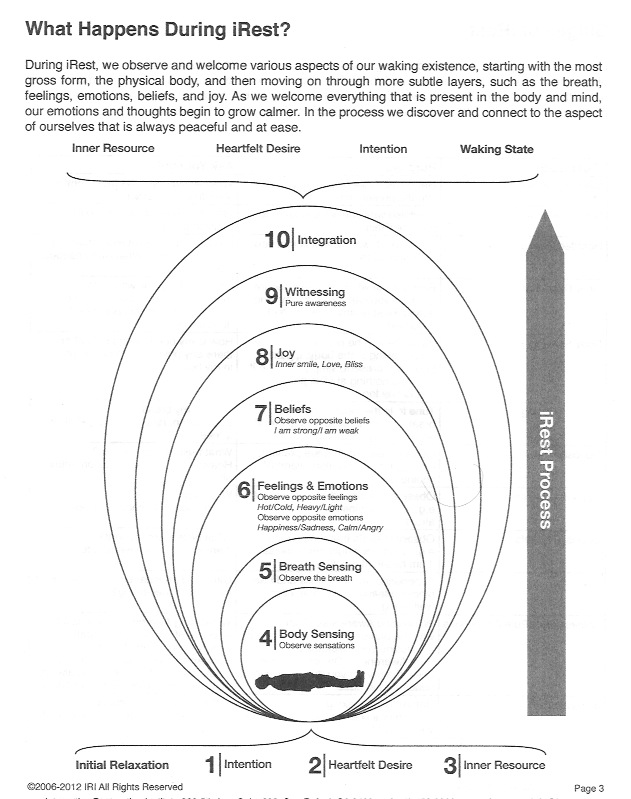
iRest (Yoga Nidra) for this particular group is a wonderful offering, especially when delivering certain aspects of the practice that are sensate oriented, such as body sensing and breath awareness. 

These practices are focused in the here and now, and can help this population feel at ease and calm. Also imagery can be a useful aspect by bringing in images that the individuals give you and speaking them back, like you are taking them on a beautiful and present focused journey. 

I also think any way to interweave joy through things like chocolate meditations, smelling flowers, holding hands in the heart to evoke feelings of love, etc., can be wonderful elements to weave into a practice. 

Using hands on materials like we do with kids, i.e., cloth or textures to touch, things to smell (floors) or hear (bells) or see (die settling into a water vase.) 

The sky is the limit. Just our imagination as teachers as to what we can bring to enliven the senses, nourish the felt sense of being and being in the hare an now, etc.


Saturday, March 16, 2013

Meditation: Round 2: Practice 3

For this practice (which is what we call the meditation session) there were only two of us with Corinne. The other person and I have been with Corinne previously so she decided, with our permission, to take a different approach. You know the "stress" I am under and the other person had just experienced a health emergency. She had to go through that ordeal herself and mentioned that the use of her Yoga Nidra techniques helped her through the ordeal.

In this practice, we decided to look more closely at emotions in addition to working our way through all 14 steps of the practice (you've seen the diagram previously.) During the Emotions part you observe emotions that are present (now that you are in a comfortable, relaxed state,) inquire about what these emotions are telling you, concentrate on the emotion and then on its opposite. The purpose of looking at an emotion from both sides is that emotions are in flux and one is on a continuum between the positive of the emotion and the negative of the emotion. Often during a practice, you notice the emotion and know that you do not have to deal with it right then. But you must acknowledge it and deal with it later if you do not want it to increase in intensity. This time we were going to concentrate on the emotions.

The emotion that came to me, again, was JOY. Its opposite, SORROW. If you have been following these Yoga BLOGs you will know that this seems to be a recurring theme for me.

When Corinne asked us to look at our Essential Self (that which we are in relation to the universe) vs our Essential Nature (that which we have become based on experiences, expectations, relations to others and society) in relation to this continuum of emotion I felt blocked. My life most of the time is so wrapped up with trying to be the best me I can be to support Gregory, and my guilt at falling short of my expectations for myself that for some reason when trying to look through the vail I am unable to see "the real me."

Then this visualization and verbiage came to me. Yes JOY is all around me (picture me in the center of embracing hands with the hands being JOY, my essential self is in the center of these hands but without Gregory as part of my life, I cannot see through to my essential self. It is as if our souls, our spirits are so closely joined that I cannot tell one apart from the other. It feels, as Gregory continues to disintegrate day by day, that my soul is being CLEAVED in two. Split. Torn. Cleaved as in cleaver.

Corinne proposed a series of images in which we could weigh the emotions we choose and each one was diminished in light of not being able to appreciate them with Gregory: a spring day, a child's toy, a beautiful flower, etc I was so sad and knew that I could return to my Inner Resource (Forest) for protection but I chose to stay with the difficulty of looking at the joy/sorrow emotion.

So most of the time, while I know JOY exists and I do see and celebrate it, I am mostly wrapped up in SORROW and the suffering it brings. Soon after we slowly came back to the witnessing of the experience/practice and slowly returned to the waking state at the end of the practice. As I took the eye cover off, tears streamed out of my eyes and down my face. I was not crying on the outside but my emotions inside had caused the flood. It was a strange feeling. It was as if my eyes were crying but I wasn't.

Am still analyzing the experience but it probably seems obvious that my love for Gregory, our 35+ years together in such a strong, respectful, supportive relationship has united our spirits so strongly into one unique spirit that with the Alzheimer's Journey which we are currently on, and the insidious nature of the disease, the untying of those spirits is no easy task and extremely painful. Yes, JOY but also SORROW.


Sunday, November 25, 2012

Meditation

Last week in my Nidra Yoga Meditation class I realized that instead of being better able to deal with my impatience and at times lack of compassion for Gregory, I needed to work on dealing with the feeling that I get in my chest when an interaction or communication with Gregory goes awry. If I can identify the "feeling" when it arrives and diffuse it, I will be patient and compassionate even more than I usually am. It is the confusion, fear, and anger behind the "feeling" that causes me to be impatient. One step closer to perfection '-)

I am taking a class at the Heartwood Center in Evanston with Corinne Peterson.
http://www.corinnepeterson.com/yoga-therapy/

Meditation

Today in my Mindful Meditation Yoga class I realized that I can hold joy within me and keep sadness on the outside. I can invite the sadness in when I want to process it but I do not have to live with it and do not have to let it in uninvited.


I am taking a class at the Heartwood Center in Evanston with Corinne Peterson.
http://www.corinnepeterson.com/yoga-therapy/