FOR GREGORY. He was not a VICTIM of ALZHEIMER'S DISEASE, he was a HERO!

PLEASE NOTE: Even though this blog is now dormant there are many useful, insightful posts. Scroll back from the end or forward from the beginning. Also, check out my writer's blog. Periodically I will add posts here if they provide additional information about living well with Dementia / Alzheimer's Disease.

Showing posts with label Reactions. Show all posts

Monday, September 30, 2013

Detachment


More and more, the tenants and writings of Buddhism talk to me of my life and more importantly my journey with Gregory through and beyond Alzheimer's.
—S.N. Goenka, “The Art of Living: Vipassana Meditation”, from The Buddha is Still Teaching: Contemporary Buddhist Wisdom, selected and edited by Jack Kornfield
By learning to remain balanced in the face of everything experienced inside, one develops detachment towards all that one encounters in external situations as well. However, this detachment is not escapism or indifference to the problems of the world. Those who regularly practice Vipassana become more sensitive to the sufferings of others and do their utmost to relieve suffering in whatever way they can—not with any agitation, but with a mind full of love, compassion, and equanimity. They learn holy indifference—how to be fully committed, fully involved in helping others, while at the same time maintaining balance of mind. In this way they remain peaceful and happy while working for the peace and happiness of others.
This is what the Buddha taught: an art of living. He never established or taught any religion, any “ism.” He never instructed those who came to him to practice any rites or rituals, any empty formalities. Instead, he taught them just to observe nature as it is by observing the reality inside. Out of ignorance, we keep reacting in ways which harm ourselves and others. But when wisdom arises—the wisdom of observing reality as it is—this habit of reacting falls away. When we cease to react blindly, then we are capable of real action—action proceeding from a balanced mind, a mind which sees and understands the truth. Such action can only be positive, creative, helpful to ourselves and to others.
Today we say goodbye to a teacher who had an immense impact on the world. S.N. Goenka was a pioneer in making Vipassana meditation widely available to a secular audience. Over 170 meditation centers have been established around the globe under his auspices. His legacy will resound indefinitely. 

Monday, May 27, 2013

Balancing Emotions

The article "Balancing Emotions," reproduced below, helped me gain yet another insight into why I react to difficult interactions with Gregory in ways with which I am not happy and which I am trying to change.  

For this post, I want to concentrate on this particular part of the article: 

Emotions and inner patterns of behavior arise like waves of energy within us. They take the form of feelings and reactions that play out over and over again. These patterns are very habitual: a trigger comes and the pattern arises. Sometimes, we do not even need the trigger; the pattern is just there.

After 35+ years of life and love with Gregory, we have many shared experiences and have learned many patterns of interaction. Now, ten years into our Journey with Alzheimer's Disease, many or most of those old patterns of interaction have changed or disappeared. We have compensated, revised, tweaked, changed, dropped, and added to our repertoire.

Often our interactions are based on Gregory's current normal (which is somewhat crazy) but to keep our life as normal as possible, I also try to interact with Gregory like I always have. When an interaction goes awry I still react as if Gregory is normal, as if the interaction should have been normal, as if our relationship still is normal. However, he is not and they are not. So I get angry, impatient, frustrated, and at times disrespectful.

The old patterns arise like waves of energy and are habitual, but because the old normal is mismatched with the new normal, the energy is often negative. Angry energy. Disrespectful energy. Impatient energy. Frustrated energy. Confused energy. 

Even though I have worked at changing many of our patterns, many more of the old ones still surface without needing a trigger. In looking at myself over the last ten years, what I have had to do is relearn and analyze my patterns of behavior and make sure they mesh with the "New Normal" that Gregory and I are living now. 

Sometimes I am able, other times I am not. Part of the problem is that the "New Normal" will be new yet again later tonight, tomorrow, and the next day etc etc etc. I'll keep trying.

Balancing Emotions 
From: tricycle: The Buddhist Review, Spring 2013.
A discussion by Lawrence Levy, founder and senior member of the Juniper School, based on a workshop by and the teachings of Segyu Rinpoche.
Long devoted to translating traditional Buddhist teachings into contemporary idiom, the Silicon Valley–based Juniper School, led by Segyu Rinpoche, has in the past few years reached out to the general public with its accessible teachings. Here, a senior member of the school describes the practice of Balancing Emotions, one of the “four building blocks of Buddhist training” (the other three practices are Meditation, Cultivating Compassion, and Developing Insight). In March, Segyu Rinpoche, a Brazilian-born lineage holder in the Tibetan Gelug tradition, will offer a four-part video retreat on all four practices at tricycle.com.
Balancing Emotions means gaining control over the mood and outlook we bring to everything we do. Our inner emotions have an enormous effect on our experience, often impeding our inner growth. Balancing our emotional energy can create a significant shift in our inner well-being, creating new levels of inner strength and tranquility.
—The Juniper School
One of the great insights of Buddhist thought is the central role of emotions and inner patterns of behavior in our experience. Strong cravings and emotional patterns color almost everything we do, sometimes keeping our minds disturbed for long periods and often upsetting our personal and professional lives. Although our emotions are normal aspects of experience, they can become like mental prisons. A single word, or even a look, from another person can trigger a range of emotions that consume us for hours, weeks, or longer. These inner states typically are present regardless of our outer endeavors and attainments, and they can be highly resistant to change. Wealth, fame, and other worldly successes, for example, often fail to provide the contentment we anticipated because they do little to change the emotions and patterns of behavior that govern how we feel.
Emotions and inner patterns of behavior arise like waves of energy within us. They take the form of feelings and reactions that play out over and over again. These patterns are very habitual: a trigger comes and the pattern arises. Sometimes, we do not even need the trigger; the pattern is just there. This emotional energy incites us to action, driving our mood, experience, and interactions with others. It can make us do things we do not want to do, leaving us to rationalize our behavior or to regret our actions. When our emotional energy rises, it is difficult to dissipate it at will. It needs to run its course. Consider, for example, how anger, envy, resentment, lust, and other emotions can dominate our mood and attention. Buddhist training gives us tools to bring these waves of emotional energy into balance.
To gain this balance, first we have to commit to learning about ourselves and growing. This is often not as easy as it sounds. For example, we have a strong tendency to blame problems on outer conditions—the boss, the neighbor, the friend, the economy, the family, the environment, and the like. We tend to convince ourselves that if outer circumstances were to change—if we had more money, more fun, more friends, more free time, more respect, better relationships, and so on—things would be better. However, although outer changes may help, we often give them too much weight, and we have difficulty seeing the obstacles created by the inner forces at work.
Once we acknowledge the importance of looking within ourselves, we have to elevate our awareness of how our emotions and patterns of behavior affect us. We begin to see the impact on our lives of our emotions, our inner patterns of behavior, and the inner stories that dictate how we see ourselves and the world around us. Becoming aware of these inner forces is key to changing them. Just the awareness can make a difference.
Having enhanced our awareness of our emotions and patterns of behavior, we can apply remedies that will reduce or eliminate those that cause inner agitation. These remedies include committing to a path of inner development, meditating, exercising self-restraint, and cultivating positive modes of thought and action. Buddhist training guides how to do each of these.
However, we must be careful not to suppress or bury our emotions; then the energy just finds its way somewhere else. Instead, by gently robbing negative emotional patterns of their power and by practicing positive modes of thought and action, we bring balance to our inner lives, and our minds will gradually become habituated to remaining calm, stable, and clear. 

Saturday, April 13, 2013

Gregory's Meditation Session One

Yoga Nidra with Corinne Peterson has been so beneficial for me that I decided to see if it would be of benefit to Gregory. The concept was not to follow Yoga Nidra exactly, but to allow Gregory some "time away from himself." Often he is frustrated when he can't tell you what he is thinking, or he struggles to figure out how to cut a piece of meat or brush his teeth. The more time we can allow him free from pain, distraction, frustration etc the better. So we are calling this, as we have called other experiences, "A Nobel Experiment."

Corinne and I began an e-mail dialogue on what a Practice (yoga session) might look like for someone with Alzheimer's. We needed to take into consideration language and communication difficulties, Gregory's inability to focus on complicated directions, and other Alzheimer's issues. We were concerned that he would not be able to give us feedback on the process.

Following are some of the thoughts Corinne and I shared:

"We've talked a little about what the session on Thursday might feel like. Here are a few more thoughts and suggestions. I am just thinking out loud, you are the expert in Yoga Nidra, I am somewhat the expert in Alzheimer's although Gregory is the real expert in Alzhiemer's, just unable to share his expertise.

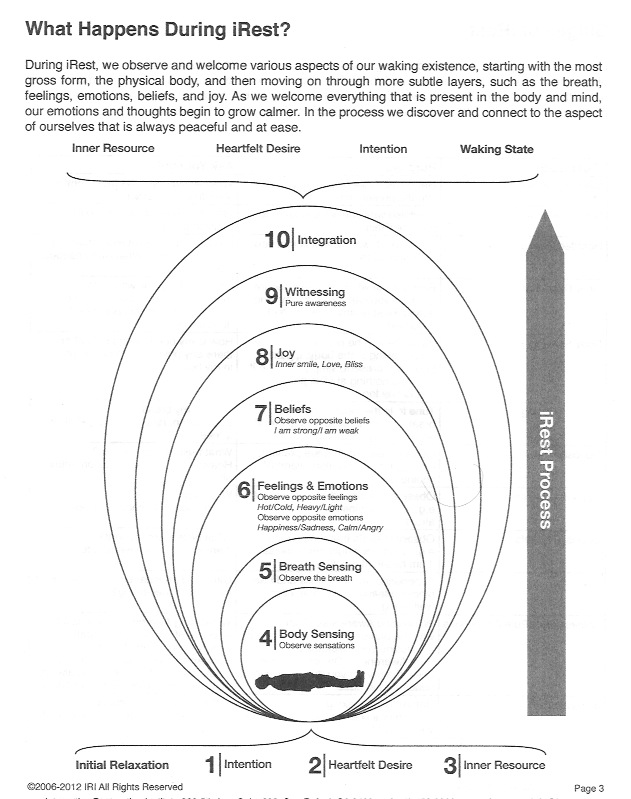
Spend most of the time in levels 4, 5, and 6.


Use less detail. Start at head and work your way down to toes but do so simply. For example "be aware of your mouth." Don't complicate it by "left mouth" "right mouth" "top of mouth" "bottom of mouth." etc. Lips-OK, Tongue-Ok, Teeth-Ok for example but leave the detail out? 

Hands - OK. Fingers - OK but leave out left and right. Leave out thumb, pinkie, ring finger, etc. Allow enough space for him to process the suggestions made. We will have to play this one by ear, maybe his face will cue us? 

For 5 breathing and noticing in and out is good. A countdown from 12 to 1. Gregory cannot count by himself. Instructive: "We will count our breaths down from 12. Breath in, breath out 12. Breath in, breath out 11. etc. Our breathing could be loud enough to guide him as you cue.

For 6: one or two emotions. Happiness and Sadness for example. After suggesting the emotion, maybe let Gregory create his own thoughts during the silence instead of complicating it by offering options or alternatives. Then go to Sadness and let him create what makes him sad. Then come back to happiness and leave it on the positive note. Maybe the word itself will be enough for Gregory to think about.

End with a guided imagery through a forest. Suggest the images leaving a lot of quiet space for him to process. Something like "Lets be quiet for a while and think about a forest." His processing is so slow that the space is important. Perhaps offering generalities of a forest and again allow space for his processing would help. Picture the trees......  Do you see the sun shining through the trees... Picture the path..... Do you see any animals.....

Allowing the right amount of space for him to process the suggestions is important. Not too much. Not too little. We will have to play this one by ear, maybe his face will cue? 

Corinne, based on our conversations the last few times, how does all this sound to you? The goal is to tailor the session to Gregory. I am just coming along for the ride so don't worry about making it meaningful for me. I will probably have as my intention to entrain with Gregory to "feel" how it is going for him. 

Looking forward to the session.


• • • • •

Corinne,
Thanks for today. I think it was a great success. Your pacing was perfect as was your simplicity of suggestion. We do not need to know exactly what Gregory experienced in detail but I think his "waking" reactions were very telling as to your success. (Two thumbs up. "Wonderful." "Amazing." I was SO PLEASED! Did you notice the tears in my eyes? Joy!
Michael

Corinne shared an e-mail that Richard Miller sent in answer to someone's query about Yoga Nidra and people with dementia.  He is the guru of Yoga Nidra and her teacher. It was interesting to see how what he had to say overlapped Corinne and my discussions.

iRest (Yoga Nidra) for this particular group is a wonderful offering, especially when delivering certain aspects of the practice that are sensate oriented, such as body sensing and breath awareness. 

These practices are focused in the here and now, and can help this population feel at ease and calm. Also imagery can be a useful aspect by bringing in images that the individuals give you and speaking them back, like you are taking them on a beautiful and present focused journey. 

I also think any way to interweave joy through things like chocolate meditations, smelling flowers, holding hands in the heart to evoke feelings of love, etc., can be wonderful elements to weave into a practice. 

Using hands on materials like we do with kids, i.e., cloth or textures to touch, things to smell (floors) or hear (bells) or see (die settling into a water vase.) 

The sky is the limit. Just our imagination as teachers as to what we can bring to enliven the senses, nourish the felt sense of being and being in the hare an now, etc.


Tuesday, January 10, 2012

Daily Word


Daily Word: Daily Inspiration From Unity
About Daily Word | Pray | Affirmations | Articles | Search Archives | Subscribe | Shop | Donate
Today's Daily Word
Tuesday, January 10, 2012
TRANSITION
I move forward through change.
While change is inevitable, my response or reaction to change is up to me. How can I best prepare myself for change, and how can I make the most of it?
Change is a transition from one thing, one place, one state of mind to another. I am evolving from what was to what is. I am becoming more than I was before. Just as my view changed as I transitioned from childhood to adulthood, I now see that I am gaining a new perspective during this transition.
I may be stepping into unfamiliar territory, but this step is an opportunity to grow in spiritual awareness. With each shift or change in my life, I am moving forward.
When I was a child, I spoke like a child, I thought like a child ...; when I became an adult, I put an end to childish ways.--1 Corinthians 13:11

Saturday, November 26, 2011

Conversations

Sometimes I will have a conversation with Gregory after a trying exchange. I will explain why I reacted as I did and how I plan to try to react in the future. I explain my rational. Most likely he does not remember the conversation but I cannot say for sure that he doesn't. What I do know is that I cannot bring myself to change my behavior or approach to him without trying to explain it. Possibly it is my way of explaining to myself what I need to do to be a better caregiving partner and possibly my way of holding onto our relationship as a "couple" rather than being an individual making unilateral decisions. Gregory seems to appreciate my sharing my feelings with him.

This is how one such "conversation" went last night. While he was not remembering how to put on his night shirt, brush his teeth, or swallow his pills I held back and said or did nothing. I have found that if I try to anticipate his needs, guess his needs, or intervene too soon ... I only serve as a further distraction. Sometimes given enough time he will solve his own problem. Periodically I tell him that "I am holding back to give you space." He seems to appreciate that.

I have decided (for now) and told him that I do not think it is fair or respectful to him when I take over without being asked. I reviewed that we have talked about previously about my helping often being more of a distraction and hinderance than a help. I told him that if he needed help, he needed to ask for it and I would give it freely, gladly, and supportively.

But I just need to stop jumping in too soon (especially if it isn't a matter of safety.) This is a very difficult stance for me because it is very difficult for me to just watch or see him suffer and do nothing. He may or may not remember to ask for help but I will mention this every now and then as a possible reminder. Obviously I will also be monitoring his needs and make changes as needed. For example if he continues having trouble swallowing his medications and vitamins, I have found a liquid substitute. I just don't want to assume that it is needed now.