FOR GREGORY. He was not a VICTIM of ALZHEIMER'S DISEASE, he was a HERO!

PLEASE NOTE: Even though this blog is now dormant there are many useful, insightful posts. Scroll back from the end or forward from the beginning. Also, check out my writer's blog. Periodically I will add posts here if they provide additional information about living well with Dementia / Alzheimer's Disease.

Showing posts with label Simplicity. Show all posts

Sunday, October 12, 2014

Visiting

Visited Gregory yesterday. Arrived before dinner and visited. Sat during dinner and visited. Went back to his room after dinner and visited.

Visited. What does that mean?

In our narrow world it means repetition and simplicity. Playing, eating, sipping water or juice, watching South Pacific (over and over again,) putting on a "Peaceful the Bear" puppet show.

Sometimes just quietly hold hands while we sit together, him in his wheel chair and me on a stool at his side. He doses off. I look at him closely, wondering.

The other day, my outer voice said, "I miss Gregory."

My inner voice said, "You shouldn't miss Gregory. He is still with you."

I realized that what I miss is my old life with Gregory. In many ways even when he was a lot more available that "old life" had passed with only the memories left.

It was an abrupt, unexpected ending last January 2014 when I had to call 911 to help me deal with his violence and then to find Lieberman Memory Care Center for him.

But that was ten months ago and both Gregory and I have settled into our new lives.

What I miss is living with a person in a relationship that has 40 years of experience and practice. I miss the little sound bites, little sayings, little doings that no longer exist. I miss our conversations. I miss waking up in the morning next to him. I miss sharing a dinner out. There is so much I miss.

But amazingly enough, Gregory and I continue to build new experiences based on his current level of ability. I pop a mini-cookie into his mouth and he replies "mmmm." I stick a pretzel rod into his mouth and let go. He knows to reach up and hold it and finish eating it.

If the half a cup of water is left close enough, sometimes he reaches over picks it up to take a drink. When he gets nervous that his wheel chair is being pushed down the hall too quickly, I reply, "No, it's OK. I am a safe drive. A very safe driver."

We do "forehead kisses" by leaning our foreheads against each other in a 30 or 60 second "embrace." We kiss on the lips. I make a loud smacking, high school newly learned how to kiss sound to make sure he gets the idea. Recently he has begun making the sound too. Sometimes when we kiss he says, "More."

He does his "jabber routines" in various languages. They make no sense but he is able to carry on and then we both giggle at his joking in Russian, Yiddish, Italian, Insane Person.

He will give me a "look" and I will ask, "What?" He will say "What?" in return. We go back and forth maybe some 6 or a dozen times: What? What? What? What? Then we giggle.

When he tries to say something or tell me something and gets frustrated at being unable to do so, all I have to do is say, "I know." And he calms down, trusting that I do understand. Sometimes I do, most of the time I only understand that he is upset and that my sound bite can settle him.

I tell him stories about his, our past and he seems to enjoy them. Sometimes he gets melancholic but usually with a sadness of joy at remembering.

In his world, our life is full. In my world, I am content. Or as I say "STRANGELY CONTENT."

Saturday, August 16, 2014

Ten Tips From Dotty

In this article they used a word I like: The Deeply Forgetful!

Dotty, Alzheimer's Reading Room
Dotty
Went to Heaven on May 25, 2012

Dotty's Ten Tips for Communicating with a Person Living with Dementia 
  1. You know what makes me feel safe, secure, and happy? A smile.
  2. Did you ever conside this? When you get tense and uptight it makes me feel tense and uptight.
  3. Instead of getting all bent out of shape when I do something that seems perfectly normal to me, and perfectly nutty to you, why not just smile at me? It will take the edge off the situation all the way around.
  4. Please try to understand and remember it is my short term memory, my right now memory, that is gone -- don't talk so fast, or use so many words.
  5. You know what I am going to say if you go off into long winded explanations on why we should do something? I am going to say No, because I can never be certain if you are asking me to do something I like, or drink a bottle of castor oil. So I'll just say No to be safe.
  6. Slow down. And don't sneak up on me and start talking. Did I tell you I like smiles?
  7. Make sure you have my attention before you start blabbering away. What is going to happen if you start blabbering away and you don't have my attention, or confuse me? I am going to sayNo - count on it.
  8. My attention span and ability to pay attention are not as good as they once were, please make eye contact with me before you start talking. A nice smile always gets my attention. Did I mention that before?
  9. Sometimes you talk to me like I am a child or an idiot. How would you like it if I did that to you? Go to your room and think about this. Don't come back and tell me you are sorry, I won't know what you are talking about. Just stop doing it and we will get along very well, and probably better than you think.
  10. You talk too much -- instead try taking my hand and leading the way. I need a guide not a person to nag me all the time.

Thursday, February 6, 2014

Simplicity, Patience, Compassion

Enlightened Heart

SIMPLICITY
PATIENCE
COMPASSION

A Poem by Lao-Tzu
571-??? B.C.

Edited by Stephen Mitchell  

A copy of this post-it has lived on the side of Gregory's nightstand for years. Every night before closing the lights he would read the three words aloud: SIMPLICITY, PATIENCE, COMPASSION.

To this day, with all the very difficult times and changes he has gone through since Christmas 2013, Gregory continues to strongly hold onto these tenets in his daily actions.

Currently he has embraced and is comfortable at the Lieberman Center where his life is now the embodiment of SIMPLICITY. Minimum activity but routinely so. Blue jeans and a nice shirt but no need to think about how you look. Nutritious meals but predictable, nothing fancy. Same activities at the same time on the same day. Not many choices to ponder.

PATIENCE certainly as the hours, no the minutes, no the seconds pass in a row without much disruption or variation. Sitting and waiting for what comes next without much thought about what it is that will come next. It just arrives. In your chair by 4:00, at your table, in the dining room in time for a 4:30 dinner which isn't always delivered to you until a while later. Lots of waiting for little (according to my eye) reward. But to Gregory's eye, just part of life and his ability to be patient.

As we walk around the four sections of his floor, we stop at each oversized photograph of something Chicago and discuss it. Lake Michigan. Lincoln Park, Museums. Etc. Every now and then we pass someone in the hall. Someone in a wheel chair, quiet, unable to do for themselves, mostly unable to communicate. Sometimes a hand is stretched out towards us. As we pass, each time someone calls out or reaches out, a holding of hands. Gregory will respond with a look of love, a gesture of caring, a smile. COMPASSION. Compassion personified!

Boy I love that man.

Saturday, April 13, 2013

Gregory's Meditation Session One

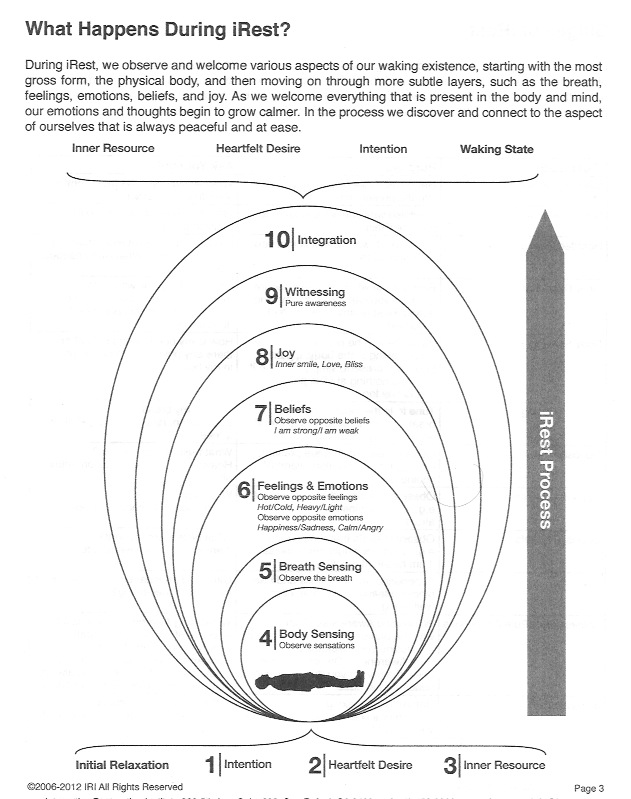
Yoga Nidra with Corinne Peterson has been so beneficial for me that I decided to see if it would be of benefit to Gregory. The concept was not to follow Yoga Nidra exactly, but to allow Gregory some "time away from himself." Often he is frustrated when he can't tell you what he is thinking, or he struggles to figure out how to cut a piece of meat or brush his teeth. The more time we can allow him free from pain, distraction, frustration etc the better. So we are calling this, as we have called other experiences, "A Nobel Experiment."

Corinne and I began an e-mail dialogue on what a Practice (yoga session) might look like for someone with Alzheimer's. We needed to take into consideration language and communication difficulties, Gregory's inability to focus on complicated directions, and other Alzheimer's issues. We were concerned that he would not be able to give us feedback on the process.

Following are some of the thoughts Corinne and I shared:

"We've talked a little about what the session on Thursday might feel like. Here are a few more thoughts and suggestions. I am just thinking out loud, you are the expert in Yoga Nidra, I am somewhat the expert in Alzheimer's although Gregory is the real expert in Alzhiemer's, just unable to share his expertise.

Spend most of the time in levels 4, 5, and 6.


Use less detail. Start at head and work your way down to toes but do so simply. For example "be aware of your mouth." Don't complicate it by "left mouth" "right mouth" "top of mouth" "bottom of mouth." etc. Lips-OK, Tongue-Ok, Teeth-Ok for example but leave the detail out? 

Hands - OK. Fingers - OK but leave out left and right. Leave out thumb, pinkie, ring finger, etc. Allow enough space for him to process the suggestions made. We will have to play this one by ear, maybe his face will cue us? 

For 5 breathing and noticing in and out is good. A countdown from 12 to 1. Gregory cannot count by himself. Instructive: "We will count our breaths down from 12. Breath in, breath out 12. Breath in, breath out 11. etc. Our breathing could be loud enough to guide him as you cue.

For 6: one or two emotions. Happiness and Sadness for example. After suggesting the emotion, maybe let Gregory create his own thoughts during the silence instead of complicating it by offering options or alternatives. Then go to Sadness and let him create what makes him sad. Then come back to happiness and leave it on the positive note. Maybe the word itself will be enough for Gregory to think about.

End with a guided imagery through a forest. Suggest the images leaving a lot of quiet space for him to process. Something like "Lets be quiet for a while and think about a forest." His processing is so slow that the space is important. Perhaps offering generalities of a forest and again allow space for his processing would help. Picture the trees......  Do you see the sun shining through the trees... Picture the path..... Do you see any animals.....

Allowing the right amount of space for him to process the suggestions is important. Not too much. Not too little. We will have to play this one by ear, maybe his face will cue? 

Corinne, based on our conversations the last few times, how does all this sound to you? The goal is to tailor the session to Gregory. I am just coming along for the ride so don't worry about making it meaningful for me. I will probably have as my intention to entrain with Gregory to "feel" how it is going for him. 

Looking forward to the session.


• • • • •

Corinne,
Thanks for today. I think it was a great success. Your pacing was perfect as was your simplicity of suggestion. We do not need to know exactly what Gregory experienced in detail but I think his "waking" reactions were very telling as to your success. (Two thumbs up. "Wonderful." "Amazing." I was SO PLEASED! Did you notice the tears in my eyes? Joy!
Michael

Corinne shared an e-mail that Richard Miller sent in answer to someone's query about Yoga Nidra and people with dementia.  He is the guru of Yoga Nidra and her teacher. It was interesting to see how what he had to say overlapped Corinne and my discussions.

iRest (Yoga Nidra) for this particular group is a wonderful offering, especially when delivering certain aspects of the practice that are sensate oriented, such as body sensing and breath awareness. 

These practices are focused in the here and now, and can help this population feel at ease and calm. Also imagery can be a useful aspect by bringing in images that the individuals give you and speaking them back, like you are taking them on a beautiful and present focused journey. 

I also think any way to interweave joy through things like chocolate meditations, smelling flowers, holding hands in the heart to evoke feelings of love, etc., can be wonderful elements to weave into a practice. 

Using hands on materials like we do with kids, i.e., cloth or textures to touch, things to smell (floors) or hear (bells) or see (die settling into a water vase.) 

The sky is the limit. Just our imagination as teachers as to what we can bring to enliven the senses, nourish the felt sense of being and being in the hare an now, etc.


Sunday, October 28, 2012

There Are Good Days

Try as I might to post about the good days, it is most often the bad ones that send me to my computer to contemplate, to process, to poeticize.

So when you see a string of posts, you can probably guess that the marry-go-round is spinning wildly out of control.

When you see a string of NO-posts, you can probably assume that for the most part things are mostly under control and I am coping.

Under any of these scenarios you may assume that Gregory feels content, happy, and safe.

As he signs off each evening, reading aloud the words I printed on a Post-It from a poem called "The Enlightened Heart:"
SIMPLICITY, PATIENCE, and COMPASSION." 

These are his guidelines and my aspirations.

Monday, September 10, 2012

Gregory's Mantra

I may have written about this before but it is worth doing again.

Every night before Gregory goes to bed he recites his "mantra." The mantra comes from a poem by Lao Tzu (born around 571) in a book called "The Enlightened Heart: An Anthology of Sacred Poetry" edited by Stephen Mitchell.


The poem in its entirety reads:

“Simplicity, patience, compassion.
These three are your greatest treasures.
Simple in actions and thoughts, you return to the source of being.
Patient with both friends and enemies,
you accord with the way things are.
Compassionate toward yourself,
you reconcile all beings in the world.” 

― Lao TzuTao Te Ching

Every night before Gregory goes to bed he recites his "mantra:" 


Simplicity
Patience
Compassion

Simplicity, patience, compassion ... as Gregory returns to his source of being, as he lives with the way things are, as he reconciles his here and now in the world.


Thursday, February 3, 2011

Write Don't Talk! Or At Least Speak Plainly and Simply

These are a few wonderful tips from an article in the Blue Cross Blue Shield newsletter. We rely on speech so strongly that when a person with Alzheimer's is unable to use language times get rough. A suggestions for people with advanced dementia is to write a simple, brief note using large letters to communicate. Have the person read the note and see the response.

Also creating a "Memory Book" with pictures of family helps to unlock stored memories that a person with Alzheimer's just can't get out in a chat. It's not that the person has forgotten, they just need help with remembering. Creating a book with commonly needed objects or activities is another way to communicate.

Neither of these techniques are necessary yet with us but they are good to keep in mind. With Gregory, I have found that simple sentences, spoken slowly (but not insultingly,) after I have Gregory's attention usually do the job. One or two ideas at a time is the most he can handle when I ask him to do something.

I have made signs to help him remember including: 1) by the table near the front door where we keep our pocket stuff - FOR YOUR POCKET - wallet, keys, cell phone, Chapstick, etc. 2) On a shelf in the closet by the front door is a list: COAT, SCARF, GLOVES, EARMUFFS? 3) On the inside of one of the kitchen cabinets is a sign with a column for each day of the week and pictures of what to have for breakfast on each day. This helps Gregory alternate cereals, sausage or fish, toast or muffin. Sometimes I will write a simple note on a POST-IT and hang it on his bathroom mirror, paste it to this bedside table, or stick it to his breakfast tray.

Today these techniques work, tomorrow they may not so we will develop new ones. One day at a time!!!

Thursday, January 27, 2011

The Enlightened Heart

Last night Gregory pointed to three words in a poem he was reading in the book The Enlightened Heart. He wanted me to make a sign so he could post it on the side of his bedside table. Today we tried to find the author and title of the poem but we couldn't. Will keep looking and repost if we find it. FOUND IT! From a poem by Lao-Tsu 571B.C in a book edited by Stephen MitchellMeanwhile, I think it is very telling that he chose these three words as important: SIMPLICITY, PATIENCE, COMPASSION.  Every night before he turns out the lights, he reads those three words aloud. Moving?