FOR GREGORY. He was not a VICTIM of ALZHEIMER'S DISEASE, he was a HERO!

PLEASE NOTE: Even though this blog is now dormant there are many useful, insightful posts. Scroll back from the end or forward from the beginning. Also, check out my writer's blog. Periodically I will add posts here if they provide additional information about living well with Dementia / Alzheimer's Disease.

Tuesday, October 29, 2013

Technically the glass is always full! Wonderful way to look at life when you wake up every day with someone who has Alzheimer's Disease.

Monday, October 28, 2013

New Hope - But 10-15 Years Away


Largest Alzheimer’s study ever doubles the number of genes associated with the disease

By Tara Bahrampour,

In the largest-ever genetic analysis conducted on Alzheimer’s disease, an international group of researchers has identified 11 new genes associated with the disorder, doubling the number of known gene variants linked to it.

The International Genomic Alzheimer’s Project, a collaboration of two groups in the United States and two in Europe, scanned the DNA of 74,076 older volunteers from 15 countries — including people with and without the disease — to look for subtle gene variants involved in late-onset Alzheimer’s, the most common form.

The study, which appeared Sunday in Nature Genetics, provides additional evidence of the involvement of certain genes in Alzheimer’s, such as one connected to the abnormal accumulation of amyloid protein in the brain, which has been associated with the disease. It also finds new gene-related risk factors that may influence cell functions.

The 11 new genes join a growing list of known gene variants associated with late-onset Alzheimer’s. Until 2009, only one had been identified; with the new findings, the list reached 22.

The identification of so many new genes offers promising new avenues to finding drug therapies, said Gerard Schellenberg, a professor of pa­thol­ogy at the University of Pennsylvania and the head of the Alzheimer’s Disease Genetics Consortium, one of the participating U.S. groups.

“Not all are good drug targets, but the longer the list of genes that you know are implicated in a disease, the more likely you are to find one that might be a good candidate for a drug,” he said, adding that it could take 10 to 15 years to develop drug therapies based on the new findings.

The study, which was supported in part by the National Institute on Aging and other components of the National Institutes of Health, also identified 13 additional gene variants that it said merit further investigation.

Marilyn Miller, program director for the Genetics of Alzheimer’s Disease in the Division of Neuroscience at NIA, said the large scope of the study, with so many participants from so many countries, was key to its success in identifying so many new genes.

“Alzheimer’s is obviously a complex disease,” she said, “and because it is so complex, it is only because of this broad-based collaborative effort that we’ve been able to begin to find potential solutions to tackle the disease.”

© The Washington Post Company

Sunday, October 27, 2013

A Visit With Family


As usual we had a wonderful time during your visit. For Gregory, he loves you lots and enjoys your being here. For me, it is nice to have people around the house with whom I can interact. For some strange reason, it also helps when others can see how Gregory is. 

When I am here by myself, on duty 24/7, I feel unappreciated by life. Not that I need people to "fawn" over me, but having others "experience" it with me, helps! Makes me feel less alone. Makes me feel less "crazy" myself.

So thanks for hanging in there. You both did a great job of "pretending" to understand and agree with his "nonsense" conversations. With open face and interested looks.

As we were falling asleep last night, Gregory was already sawing zzzzzzz's. I lie on my side and watched him thinking how he is so far from the man I used to know and love. Sometimes I lie there and relive various parts of our wonderful life together: milestones, business ventures, travel, family, friends, theater, entertaining, Gregory's architecture, Michael's Museum. 

But at the same time, I am alright with the fact that it is what it is and I love him at each new level. Sometimes it is frustrating, sometimes it is incomprehensible, sometimes it is down right shitty (in all implications of the word :-) But again, IT IS WHAT IT IS, and for the most part, I cope. He seems happy and content. What more could I ask?

Love you more, etc.

P.S. While this was written for you two, I will share it on the BLOG because it is part of the continuing story. 

Milestone

Pleased to announce that this BLOG has just gone over 20,000 hits since its inception in June 2010. Thanks for helping.

Form Follows Funcion

Memory doesn't inform.

Telling doesn't inform.
Pointing doesn't inform.
Touching doesn't inform.
Showing doesn't inform.

Only doing for has for m.

So True


Wednesday, October 23, 2013

To Love

To truly love someone takes a great act of courage. It is the only event besides life itself which has a built in end and therefore brings fear and sadness as well as peace and joy. Either the love dies or the person you love dies and in some ways that knowledge lingers just a few steps behind all through your life.

This thought, as expressed by me, was part of the theme of last night's play at the Goodman.

Smokefall


“
October 5 - November 3, 2013
 In the Owen
Extraordinary performances”
  • — CHICAGO TRIBUNE

This lyrical new work from “formidably talented” (The New Yorker) playwright Noah Haidle explores the passage of time and the fleeting pleasures of life through three generations of a Midwestern family. 

Change is in the air as Violet prepares to bring twin boys into the world. Inside her womb, her unborn sons contemplate their future, while outside her body her world is in transformation: her husband is secretly planning to leave her, her father is slipping into senility and her daughter has taken a vow of silence.Smokefall spans the lives of this family in an expansive poetic treatise on the fragility of life and the power of love.

Monday, October 21, 2013

A Double Header Day

Post 2 of 2 (At least so far today.)

After a lovely early morning at the Botanic Garden with our friend Jake; we dropped Jake at home, did a few errands, and finally arrived home ourselves. I was tired and possibly Gregory was over tired.

I got out of the parked car and went to the trunk to collect our belongings. I walked away from the car, as I sometimes do, as Gregory was taking a little longer than usual to get himself out of the car.

I looked back and realized he had forgotten to unfasten his seat belt and was trying (his not comprehending why the difficulty) to get out of the car.

I decided that this was an occasion for me to wait and to give him the time and space to figure out how to get himself unbelted. Things quickly got more complicated. He slipped his arm from under the belt without unfastening it and tried again to get out of the car. Next he took his gloves out of his pocket and tried again. Next his ear muffs and finally his scarf before he successfully got himself partially out of his coat while still restrained.

By now he had twisted himself so badly that I am not sure he would ever have gotten out by himself but I decided I needed to wait until he realized the trouble he was in and asked for my help. I stood by patiently with a gentle look on my face but he didn't notice, or look at me or even realize even, I believe, that I was standing there ready to help.

He didn't panic or get overly frustrated so I held my ground, waiting. Finally he looked up and registered that I was there. "I'm working on it." he said.

"I will be happy to help" I replied, "just ask ... 'Michael I need some help.'"

"I need some help," came the echo. So I put the parcels I was holding on the hood and proceeded to help him. He was so badly wrapped up in belt, scarf, coat, etc that it took me a while to get him unwrapped. And I had to force his body uncomfortably through this line and over that line and around the other. He was a little panicked by now and fought me a little. I had to calm him down and proceed.

By the time we were done, it felt like I almost had to tip him on his head while he was hanging out the car door but finally WE were free from restraint.

"You forgot to unfasten the belt before you got out," I by force of habit said. And due to his disability, I am sure my comment made no difference to him. We proceeded up the stairs to the condo. He had a drink of water and took a nap as did I.

Another lovely day on a lovely outing.

S-POPS

This has been going on for a while but seems here to stay so I thought I would post about it. Gregory has developed the Sandwich Perception and Orientation Problems Syndrome. If I were a doctor I could coin the name S-POPS and become famous. The symptoms present themselves in Gregory's being unable to orient a sandwich correctly to efficiently get it into his mouth for a bite.

Imagine eating a hot dog. One tips one's head left or right while holding the hot dog parallel to the plate and bites from one end towards the other end. Thus the mustard and especially the onions and pickle relish stay on the dog during the biting process.

Next picture a cheese berger. The round bun, containing the beef and condiments, can be held at 90 degrees to the plate as the bites take place and chances are the bun will hold the contents in place.

Both above scenarios present only minor problems if one is seated at a table and can hold the said sandwich over a plate. If items fall off onto the plate, they can be picked up with your fingers (even though the fork is sitting at the right of the plate) and consumed without much problem.

More perplexing is when the long, cylindrical hot dog type sandwich or the round burger type sandwich (or for that matter the square Wonder Bread type sandwich) are aimed toward the mouth at an impossible angle for not only 1) condiment maintenance but also for 2) basic biting.

The biggest problem by far comes when trying to eat a sandwich in the car. Sometimes the wrapper snuggled around the bottom of the burger like a diaper on a baby's bottom will help, but not always especially if the angle of sandwich presentation is plus/minus the required parallel or 90 degree angle.

Possible solutions: Do not eat in the car. Wear a bib. Don't notice the difficulty and drive bravely forward.

Thursday, October 17, 2013

To Read or Not to Read

I am still trying to figure out how I can help Gregory continue to read at bedtime. Perhaps I should rehearse what I should have said instead of what I did say when he handed me his book on the same page it was on when I gave it to him an hour earlier.

He often closes the book and cannot explain where he left off. When asked "Where did you stop? or finish? or end? (various words tried on various nights) he is unable to tell me. Often he points to where he began!

I think that he still comprehends although may not remember. So each period of time spent with reading is probably an isolated event, without his being able to paint the entire picture of the story, but he still enjoys his reading.

I am afraid that another problem is that Gregory might not any longer understand the mechanics of reading. Top to bottom. Left to right. Front to back. Turn page, begin again.

I show him where to begin reading, I keep an eye on the page he is on, I note where his eyes seem to be, and I mark the place he ended reading. But you can imaging what this means then when "HE" is reading and "I" am in charge!

Last night I dozed off while he was reading, when I woke and began to mark where he had left off, I saw that he was on the same page again. After success for the last week or so, I commented, "I cannot fucking believe that you are still on the same page! Did you loose your place? Do you remember where you ended? How are we going to do this?" Nicely done, don't you think! NOT.

What happens is that with these intermittant behaviors, with the ones that come and go, the ones which are here and unexpectedly evaporate ... I react according my expectations for what is a "normal" behavior not Gregory's ever changing "normal" and I freak. I speak out of anger, out of fear, out of worry for the future, out of defeat of all the work I did to try to help him hang on to the skill a little longer.

I do not respond this way to those skills and behaviors that no longer exist or more consistently come and go or are for the most part on their way out. I have developed lowered expectations for these type of interactions and deal with them as I support him. It is the "slaps in the face" or unexpected disappearances that freak me out.

I am working on it and have gotten better but I still am BELOW satisfactory on dealing with these kinds of occurrences. Most often my reaction is seated in the deep loss and sadness and grief and devastation that I feel for what he must be going through and then I end up treating him poorly.

So perhaps I should rehearse what I should have said instead of what I did say when he handed me his book on the same page it was on when I gave it to him an hour earlier.

Say nothing and have him begin in the same place the next night. Most likely I am the only one who will remember and I'll just have to swallow my despair which will be better than treating Gregory poorly and making him feel badly.

Bring on the next defeat...


Providing Some Hope for the Future


Wednesday, October 16, 2013

One Sign of Alzheimer's

Applying honey carefully to an empty plate while the toast is still in the toaster.

Simmering


HOW TO SIMMER

Not acting on our habitual patterns is only the first step toward not harming others or ourselves. The transformative process begins at a deeper level when we contact the rawness we’re left with whenever we refrain. As a way of working with our aggressive tendencies, Dzigar Kongtrül teaches the nonviolent practice of simmering. He says that rather than “boil in our aggression like a piece of meat cooking in a soup,” we simmer in it. We allow ourselves to wait, to sit patiently with the urge to act or speak in our usual ways and feel the full force of that urge without turning away or giving in. Neither repressing nor rejecting, we stay in the middle between the two extremes, in the middle between yes and no, right and wrong, true and false. This is the journey of developing a kindhearted and courageous tolerance for our pain.

—Now in paperback! Living Beautifully with Uncertainty and Change by Pema Chödrönhttp://www.shambhala.com/living-beautifully-2.html

Tuesday, October 15, 2013

Meanwhile, I Die

Most nights I don't just go to sleep. I die.

There are so many things that can go wrong at bedtime and being tired myself I don't always handle them as well as I should. Although I am getting better.

The hallway from the front door to the living room runs parallel to our master bathroom. So it is sometimes difficult for Gregory to know where he needs to go to brush his teeth. This evening he was hanging out in the hallway and I asked, "What are you doing?"

As usual he couldn't really explain so I followed up with, "There isn't anything out there that you need to worry about now."

He disagreed.

I suggested, "Do you want to brush your teeth?" as he reentered the bedroom.

"Yes. That is what I was going to do."

So I pointed to the bathroom and said, "That is where you brush your teeth."

He proceeded to go into the bathroom and brush his teeth.

Meanwhile, I died.

This is a new behavior that I have just identified at bedtime, although at other times, when I tell him to go into the bathroom, or the guest bathroom, or the TV room, or the bedroom; he is not sure where I want him to go.

Brushing his teeth is also confusing. He can find the toothbrush and toothpaste (although never puts them back where they came from, I do that for him.)

Figuring out how to take off the cap on the toothpaste, squeeze a nurdle of paste onto the brush, wet the brush, and then brush and rinse works most of the time.

But every third, or seventh, or nineteenth time he get frozen at one or another of the steps so I have to unravel the mystery for him. The hard part for me is the coming and going of his intermittant ability and that clouds how I react.

Sometimes I can "swallow" my reaction, other times I comment on the absurdity of his behavior if only because after the fourteenth or fifteenth time I forget that he gets confused while brushing his teeth. I treat him like his "normal" was my "normal" and then apologize.

What I cannot do for sure is explain to him where he went wrong or why, for example, explaining to him that filling the cap with paste after taking it off the tube of tooth paste is not part of the process.

Meanwhile, I die.

Taking his daytime clothes off and putting them on the bench for me to put them in the closet doesn't always work. He stops short of his underpants and undershirt and if I say something like, "Take off the rest." That makes no sense to him. If I point, it doesn't always help. If I yank on the articles of clothing in question, that doesn't always work either.

Sometimes before I can get to him, he puts his sleep bottoms over his underwear, or puts tops or bottoms on backwards, or inside out. Sometimes he will recognize the problem but not know how to fix it. When he doesn't realize the problem, maybe I should just keep my mouth shut and accept his "normal" and not care how many layers he is wearing or in what direction they are facing. I am working at getting better at this but instead I try to help.

Meanwhile, I die.

In the next BLOG I will talk about reading at bedtime. This hasn't been working well for a while, I have tried many different approaches, sometimes they work, other times they do not. What I do know is that with all I have to do to get the house and Gregory put to bed, I no longer have time to read. I miss it ... and I die.

Sunday, October 13, 2013

Caregiving E-Mails

A series of e-mails based on a wedding reception Gregory and I attended.

C
Thanks for taking such good care of Gregory. He appreciated you to me on our way home in the car. We BOTH did a good job taking care of him and not crashing into each other too much. I know you can understand that some times I "crash" into other helpers since I am on 24/7/365 and I am mostly on "auto pilot," not that I do not think you can do a good job because I KNOW YOU CAN! It's just difficult for me to go off-line!
m

• • • • •

Mikey,
I feel some uncertainty assisting Greg as I am unsure how much is too much or too little. I also have issues nuturing. I'm not very good at it.  Greg's comprehension has greatly deteriorated since last I saw him. I worry about you and the enormous task you tackle 24/7. I admire you enormously and love Greg dearly. I feel surprised yet happy to have been acknowledged by him.
Love you lots,
C

• • • • •
C,
You are good at nurturing even though you may feel you are not! You are always very good to Gregory and to me. When it comes to assisting him, there are no clear answers. That is what makes it difficult ... for me as well.  One does what needs to be done! He might be able to guide you a little, but otherwise you just have to make educated guess decisions. It is what I do even with our 37 years of togetherness.

From what I can tell you did wonderfully well this afternoon in keeping an eye on him, getting him some food and drink, etc. Luckily you do not have to do this too often, but at parties etc it is good to know that someone is keeping him safe and happy. That is all we really can do.

Your help allowed me to photograph for C and J's party and not worry that Gregory would get lonely, or fearful, or go hungry, or wander off. You did good!
Love you lots also!
m

Precious Gifts


If you regularly follow this BLOG, you will have seen a few entries from The Daily Word that I have shared (with some minor adjustments so they fit into my belief system.)

Sunday, October 13, 2013
LIFE

I am life. I am a precious gift, and I am worthy.
Life is a precious gift to cherish, to live, and to explore. Along with the gift of living, we are given have tools to grow and succeed.

Among these gifts, we are given have strength to keep going when times get tough. We find a storehouse of energy within us. Our hearts are infused with courage and steadfastness to keep our commitment strong.

We are given have wisdom and understanding to make right choices. God’s The Universe's light illuminates our path, leading us around, over, and through any stumbling blocks to fulfillment.

And we are given love by others. We have love to share as we cultivate the many blessings of life. We are life. We are precious. We are ourselves gifts to the world! WE ARE GOD.
Let anyone who wishes take the water of life as a gift.—Revelation 22:17

Friday, October 11, 2013

Computer Passwords and Dementia or Death


Actually, you do need to share your passwords

No one stays healthy forever. At some point, your loved ones will need access to all of your accounts. You can make that job easier for them.
No reader questions today. Instead, I'm answering a question that someone should ask: In our password-protected digital world, how do you prepare for that inevitable day when you die or otherwise become incapacitated?
This is no small problem. When you're gone, or have otherwise lost the ability to remember or communicate, loved ones will need access to your email, contacts, bank accounts, and more. Without your pre-planned help, this can be quite a challenge.
[Email your tech questions to answer@pcworld.com.]
If you don't believe me, check out Google's page for Accessing a deceased person's mail. You have to gather up and snail-mail several items, including the death certificate (each official copy of which comes with a price). Part 2 of the process "will require you to get additional legal documents, including an order from a U.S. court and/or additional materials."
It would be a lot easier if someone you trust had your Google password--and other important passwords, as well.
One solution is to print out a hard copy of your passwords and store it in a safe deposit box. But you'd have to repeat the process every time you change a password. Not so good.
Here's a better one:
Pick someone who you really trust. Your spouse is an obvious choice. Or a very close friend or relative. It could even be your lawyer or accountant. For brevity's sake, I'll refer to this person as your executor.
You'll need a password manager--a program on your PC that allows you to store your passwords in an encrypted database. You should have a password manager anyway, as I explained in Manage passwords, and not just on the Web; I also recommend a couple of them in that article.
Your executor will need a password manager, as well, although it doesn't have to be the same one.
Give your executor a few key passwords--those for your Windows and mobile logons, your email account, and, of course, your password manager. Make sure they store these passwords safely in their own encrypted password manager.
If your relationship with the executor is personal rather than professional, add their key passwords to your manager, as well.
I've done that with my wife. Her Password Safe database contains a section called Lincoln. Mine contains one named Madeline.
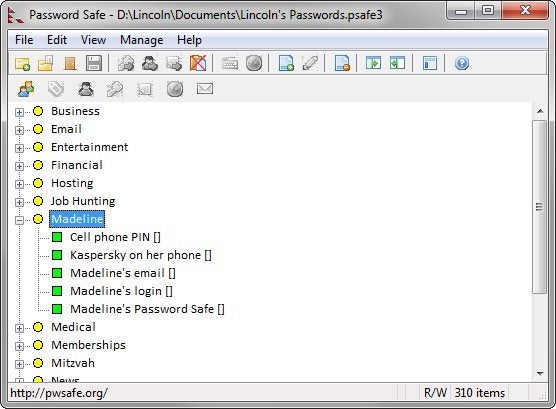
And, of course, when you change these few key passwords, make sure to put the new ones in the other person's password manager.

Tuesday, October 8, 2013

Believe: Part Three of a Trilogy

Children sleeping, snow is softly falling
Dreams are calling like bells in the distance
We were dreamers not so long ago
But one by one we all had to grow up
When it seems the magic's slipped away
We find it all again on Christmas day

This makes me cry three.


Believe in what your heart is saying
Hear the melody that's playing
There's no time to waste
There's so much to celebrate
Believe in what you feel inside 
And give your dreams the wings to fly
You have everything you need
If you just believe

Trains move quickly to their journey's end
Destinations are where we begin again
Ships go sailing far across the sea
Trusting starlight to get where they need to be
When it seems that we have lost our way
We find ourselves again on Christmas day

Believe in what your heart is saying
Hear the melody that's playing
There's no time to waste
There's so much to celebrate
Believe in what you feel inside 
And give your dreams the wings to fly
You have everything you need
If you just believe

Just believe

Never Never Land: Part Two of a Trilogy

This one makes me cry too.

I know a place where dreams are born 
And time is never planned 
It's not on any chart 
You must find it with your heart 
To come home to Never Land 

It might be miles beyond the moon 
Or right here where you stand 
Just keep an open mind 
And then suddenly you'll find 
Never Never Land 

The treasure when you stay there 
Is precious more than gold 
Once you've found your way there 
You can never grow old 

And that's my home where dreams are born 
And time is never planned 
Just think of lovely things 
And your heart will fly on wings forever 
To Never Never Land

The Rainbow Connection: Part One of a Trilogy

Makes me cry?

RAINBOW CONNECTION
Kermit the Frog

Why are there so many
Songs about rainbows
And what's on the other side
Rainbow's are visions
They're only illusions
And rainbows have nothing to hide
So we've been told and some chose to
Believe it
But I know they're wrong wait and see

Someday we'll find it
The Rainbow Connection
The lovers, the dreamers and me

Who said that every wish
Would be heard and answered
When wished on the morning star
Somebody thought of that
And someone believed it
And look what it's done so far
What's so amazing
That keeps us star gazing
What so we think we might see

Someday we'll find it
That Rainbow Connection
The lovers the dreamers and me

Have you been half asleep
And have you heard voices
I've heard them calling my name
Are these the sweet sounds that called
The young sailors
I think they're one and the same
I've heard it too many times to ignore it
There's something that I'm supposed to be

Someday we'll find it
The Rainbow Connection
The lovers, the dreamers and me

Sunday, October 6, 2013

Be Amazed. Be Amused. Be Astounded.

Morning.

Undershirt on right side out. Check.
Undershirt on right side up. Check.
Undershirt on right side front. Check.

Amusing because not usual.

Underpants on right side out. Check.
Underpants on right side up. Check.
Underpants on right side front. Check.

Amazing because not usual.

Sweatshirt on right side out. Check.
Sweatshirt on right side up. Check.
Sweatshirt on right side front. Check.

Astounding because not usual.

Sweatpants ... well that was a different story this morning.
Once upon a time ... well not that kind of story.
Sweatpants upside down being held by the legs.

Amusing.

Sweatpants turned around 360º, 2 or 3 or 4 times in a row.
Sweatpants tossed up into the air to see if that matters.
Still not quite right.

Amazing.

Spread upside down legs of sweatpants and study them.
Turn the sweatpants 360º again and study them.
Still not quite right.

Astounding.

Finally turn them over and hold by waist of sweatpants.
Put them on backwards.
Say, "Oh no." Take them off.

Finally,

Put them on right side out. Check.
Put them on right side up. Check.
Put them on right side front. Check.

Five to ten minutes later, able to move on with the morning.


Saturday, October 5, 2013

Actions Mean A Lot

Today Gregory and I went to the Farmer's Market. Evanston's market is large, loud, and busy. The day was hot and humid. I could tell all was taking a toll on Gregory. We (I) decided to stop at the Crepe Stand and have some refreshment. We (I) ordered a savory crepe with tomato, feta, and grill onions topped with a pesto sauce. Delicious.

The crepe was cut in two but served on one plate. We went over to the table area and sat down. I pushed the halves of crepe apart, gave Gregory his napkin, knife and fork. We began.

But Gregory wasn't quite sure how to begin. I prompted, "Use your knife and fork." Didn't help. My first reaction was one of frustration mixed with anger. Couldn't even sit down at the market to have a bite to eat. Life is so complicated. How can I enjoy the day, or Gregory, or my snack when everything is frustrating. Why bother.

Then something else took over. I took the knife away and gently said, "You don't really need the knife. Here let me cut it for you." I did and then showed him that it would be easier to pick up the crepe by scooping the piece with his fork rather then trying to poke it.

After my explanation, he fumbled a little more but did get the process. As I watched my (our) success, my "voice" said to me, "Act with love. Not frustration or anger."

Guess which felt better?

Monday, September 30, 2013

Detachment


More and more, the tenants and writings of Buddhism talk to me of my life and more importantly my journey with Gregory through and beyond Alzheimer's.
—S.N. Goenka, “The Art of Living: Vipassana Meditation”, from The Buddha is Still Teaching: Contemporary Buddhist Wisdom, selected and edited by Jack Kornfield
By learning to remain balanced in the face of everything experienced inside, one develops detachment towards all that one encounters in external situations as well. However, this detachment is not escapism or indifference to the problems of the world. Those who regularly practice Vipassana become more sensitive to the sufferings of others and do their utmost to relieve suffering in whatever way they can—not with any agitation, but with a mind full of love, compassion, and equanimity. They learn holy indifference—how to be fully committed, fully involved in helping others, while at the same time maintaining balance of mind. In this way they remain peaceful and happy while working for the peace and happiness of others.
This is what the Buddha taught: an art of living. He never established or taught any religion, any “ism.” He never instructed those who came to him to practice any rites or rituals, any empty formalities. Instead, he taught them just to observe nature as it is by observing the reality inside. Out of ignorance, we keep reacting in ways which harm ourselves and others. But when wisdom arises—the wisdom of observing reality as it is—this habit of reacting falls away. When we cease to react blindly, then we are capable of real action—action proceeding from a balanced mind, a mind which sees and understands the truth. Such action can only be positive, creative, helpful to ourselves and to others.
Today we say goodbye to a teacher who had an immense impact on the world. S.N. Goenka was a pioneer in making Vipassana meditation widely available to a secular audience. Over 170 meditation centers have been established around the globe under his auspices. His legacy will resound indefinitely. 

The Scourge of Helpfulness

There is an old story that goes: You can tell the difference between old age and Alzheimer's Disease. In old age you forget where you put your glasses. In Alzheimer's you forget you wear glasses!

This morning Gregory came into the bedroom. Something is wrong. He had been trying to take his morning pills in the kitchen but his glass of water was in the bedroom. Sometimes, when I am in the kitchen with him, I remind, "Your water is in the bedroom." Sometimes this helps, other times it doesn't. Other times I walk him into the bedroom and point at the water. Sometimes this helps, other times it doesn't. Still other times I take him over to the nightstand and hand him his water. Still yet other times I bring the water into the kitchen to avoid all this confusion. Either way, he does not associate having a glass of water with part of the process of taking his pills. At least not all of the time and now-a-days less and less.

Next he was at his table in the living room (which he cannot associate by name as in "Please go put this on your table.") fumbling with his reading glasses. He put them on his glass case, then next to his glass case, then under his glass case. I helped, "Put them IN your glass case." Didn't help so I backed out. This upset him so I explained, "No problem ... I tried to help but it didn't help so I backed off ... No harm done ... No babies are dying ... I love you ... That is all that matters." To which he replied, "OK."

When he sat down to read the newspaper, I realized the problem. He had some vague idea that he needed his reading glasses to read the newspaper but didn't connect the pieces, i.e. get glasses, sit down in front of your newspaper, put glasses on, read the newspaper. Instead, after the previous short circuit, he just sat in front of the newspaper confused. Again, I tried to help. I asked, "Can you read the newspaper?" "What?" "Can you see the newspaper?" "What do you mean?" So I went over and got his glasses and handed them to him. "Yes, I was going to get my glasses," he replied. OK.

Now how to handle all of this may seem obvious to you. And what I should have said, or not said, may be what you are thinking about. And I too, in looking back, realize several different ways I could of handled this. And maybe next time I will be able to handle it differently. At least this time I didn't get angry, or rude, or short, or impatient. But also I wasn't helpful. I also realize that no matter what I do, being helpful most often backfires on me.

And don't judge until you are the one trying to figure out how to go about ANYTHING with a person who is fairly advanced in Alzheimer's.

A final example. This morning he got his undershirt and underpants on correctly but had his sweatshirt on backwards. He realized this and corrected it. Next he got his sweatpants on backwards and corrected it three times only to have them on backward again. I helped, "You keep putting them on the same way. Try turning them around." So he held the pants up in front of himself and turned around. Not the pants but rather his body. Then holding the pants in front of him (oriented incorrectly) he walked forward and then backward and did this two more times. I got up and using his hands, slowly helped him to turn the pants around the correct way, in my mind trying to demonstrate the process. "Now try them on I suggested." He did, they were on the right way, but I don't think he really understood what had happened.

Somehow, I keep going.

Emptiness


This article makes me feel only a little better but when I fell "empty" I equate it with "sad." It discusses emptiness as "an infinitely open space that allows for anything to appear, change, disappear, and reappear. The basic meaning of emptiness, in other words, is openness, or potential." and for the most part, that makes me feel sad. Alzheimer's does that! It helps you focus on the negative rather than the positive. I have been working on changing that for a long time now. Sometimes it works, other times it doesn't.

THE MEANING OF EMPTINESS

—Tsoknyi Rinpoche, from The Best Buddhist Writing 2013 http://www.shambhala.com/the-best-buddhist-writing-2015.html

“Emptiness” is a rough translation of the Sanskrit term shunyata and the Tibetan term tongpa-nyi. The basic meaning of the Sanskrit word shunya is “zero,” while the Tibetan word tongpa means “empty”—not in the sense of a vacuum or a void, but rather in the sense that the basis of experience is beyond our ability to perceive with our senses and or to capture in a nice, tidy concept. Maybe a better understanding of the deep sense of the word may be “inconceivable” or “unnameable.”

So when Buddhists talk about emptiness as the basis of our being, we don’t mean that who or what we are is nothing, a zero, a point of view that can give way to a kind of cynicism. The actual teachings on emptiness imply an infinitely open space that allows for anything to appear, change, disappear, and reappear. The basic meaning of emptiness, in other words, is openness, or potential. At the basic level of our being, we are “empty” of definable characteristics.
 

Friday, September 27, 2013

A Letter to Gregory's Last Companion

Ken,

Hope all is going well with your studies, and your assistantship. We are doing as well as can be expected. If you've been reading the BLOG (not expecting such) you will know what's going on. G continues to decline but I am continuing to rise above it in his support. We miss you but honestly do not think of you too often if only because we need to let you move on. You were the first companion and not only that you proved to be a special, loving person, so you will always hold special place in our hearts.

Alaksh has settled in and is doing well with Gregory. He is slowly learning how to interact with Gregory and not to read too much into their interactions as the Alzheimer's (as you know) is so completely unpredictable. One of the many good things about Alaksh that is different than you is that he cooks! And he is good at it. We loved your Ramen adventures but I have included Alaksh's cooking as part of our weekly time. Gregory and he go to Whole Foods, and together (as much as possible) decide what we will have for dinner (I just say "Surprise me!) and Gregory helps (as much as possible) with the cooking. And as you know, since Alaksh does the cooking, I have to clean up. But it is nice to be away and come home to dinner on the table. 

I am about to send my second volume of poetry to the publisher. When it is ready, I'll send you a copy. It is called, "Sit With Me A While Longer." It has at least as many if not a few more poems than the first volume and has lots more "chair" pictures. I am pleased with the results and as you can imagine many of the poems are informed by our journey with the big "A."

We are enjoying the beginning of fall, have mums on the balcony, and have been having the windows open more. Our kitties are now cats, continue to develop separate but interesting personalities and while they are the "demons from hell" at times, we love them and they give a lot back to us with their own kind of love.

Take care, I still have your pillow case and will mail it soon.

Fondly,
Michael (and Gregory)

Thursday, September 26, 2013

Persevering Through Alzheimer's Disease

Persevering Through Mid-Stage Alzheimer’s Disease
By Kristine Dwyer, Staff Writer

Caring for a person with Alzheimer's disease (AD) is a difficult task as each day brings unique challenges and the caregiver copes with changing levels of ability and new patterns of behavior. In recent years, attempts have been made to categorize the stages of Alzheimer’s in order to gauge the progression of the disease. Staging systems can provide useful frames of reference for understanding how the disease may develop and can assist physicians in treating patients. Awareness of these stages can also help caregivers to prepare for their loved one’s needs, as well as determine their own capacity for coping and planning ahead...

Click here t o go to caregiver.com to read the entire article. It is an excellent overview of the general stages of Alzheimer's although each person demonstrates them in their own way and in their own timeframe. I would place Gregory, for the most part, at Stage 6 out of 7 but being young when he was diagnosed, he is completely healthy!

I am allowed to post the first paragraph. To read more click the above link. 

You can read the entire article online but the printable version does not work so if you want me to, leave a comment and I will send you a pdf or WORD document of the full article.

Fondly,
Michael